
Certified Pre-Owned Mitsubishi Guide for NYC Buyers
If you’re trying to buy a car in New York City, the hard part usually isn’t finding one, it’s trusting one. Tight parking, short trips, stop-and-go traffic, and curbside bumps all make a regular used car feel like a gamble, especially when the listing looks clean but you can’t tell what happened before it landed on the lot. That’s why certified pre-owned Mitsubishi matters so much here, it gives you a more disciplined way to shop without jumping all the way to new-car pricing.

For a first-time NYC buyer, that difference is practical. A certification badge can mean the vehicle has already been screened for age, mileage, history, and condition before you even start comparing colors or trim levels, which matters more when every mistake in the city feels harder to undo. Families want fewer surprises, commuters want fewer repair headaches, and drivers moving up from a basic used car want some assurance that the next owner won’t inherit somebody else’s problem.
This guide keeps the focus on urban ownership, not generic car-shopping advice. You’ll see how Mitsubishi’s CPO standards work, what the warranty really covers, why the Outlander PHEV deserves special attention, and how to shop smart without getting buried in jargon. By the end, you should know how to read a certified listing, what questions to ask, and when a CPO Mitsubishi is the right middle path between peace of mind and price.
Table of Contents
- Introduction to Certified Pre-Owned Confidence in NYC
- What Certified Pre-Owned Mitsubishi Really Means
- Eligibility Rules and the 123 Point Inspection Explained
- Warranty Coverage and Roadside Protection You Keep
- Why CPO Matters More for Outlander PHEV and Electrified Choices
- Choosing the Right Mitsubishi Model for NYC Life
- How to Shop CPO Smart at Northstar Mitsubishi
Introduction to Certified Pre-Owned Confidence in NYC
A lot of NYC shoppers start the same way. They need a car for weekend errands, a family run across boroughs, or a commute that still involves curbside parking and a lot of braking, but they don’t want to pay new-car money for a vehicle that will spend half its life squeezed between SUVs. A certified pre-owned Mitsubishi fits that tension well because it’s meant to sit between the uncertainty of ordinary used inventory and the higher commitment of something brand new.
Why this matters in city driving
City driving changes the way people think about used cars. In suburbs, the biggest concern is usually mileage. In New York, it’s also whether the vehicle was maintained through hard usage, whether bodywork hides past damage, and whether the drivetrain has enough remaining life for short-hop traffic and repeated cold starts. CPO helps answer those questions before you ever leave your building or garage.
Practical rule: If a car is going to live in the city, the paper trail matters almost as much as the paint.
That’s the value of this guide. It speaks to a first-time buyer in Queens, a parent comparing crossovers for Brooklyn errands, or a commuter who wants a better long-term bet than a random used listing. It also helps you understand why Northstar Mitsubishi’s CPO inventory should be read as a filtered set of vehicles, not just another row of used cars.
What you’ll be able to judge
By the time you finish reading, you should be able to tell the difference between a car that is merely available and one that has been screened for certifiable condition. You’ll know what the age and mileage limits mean, why the inspection process matters, and how warranty coverage changes the ownership math for NYC drivers who need reliability more than flash.
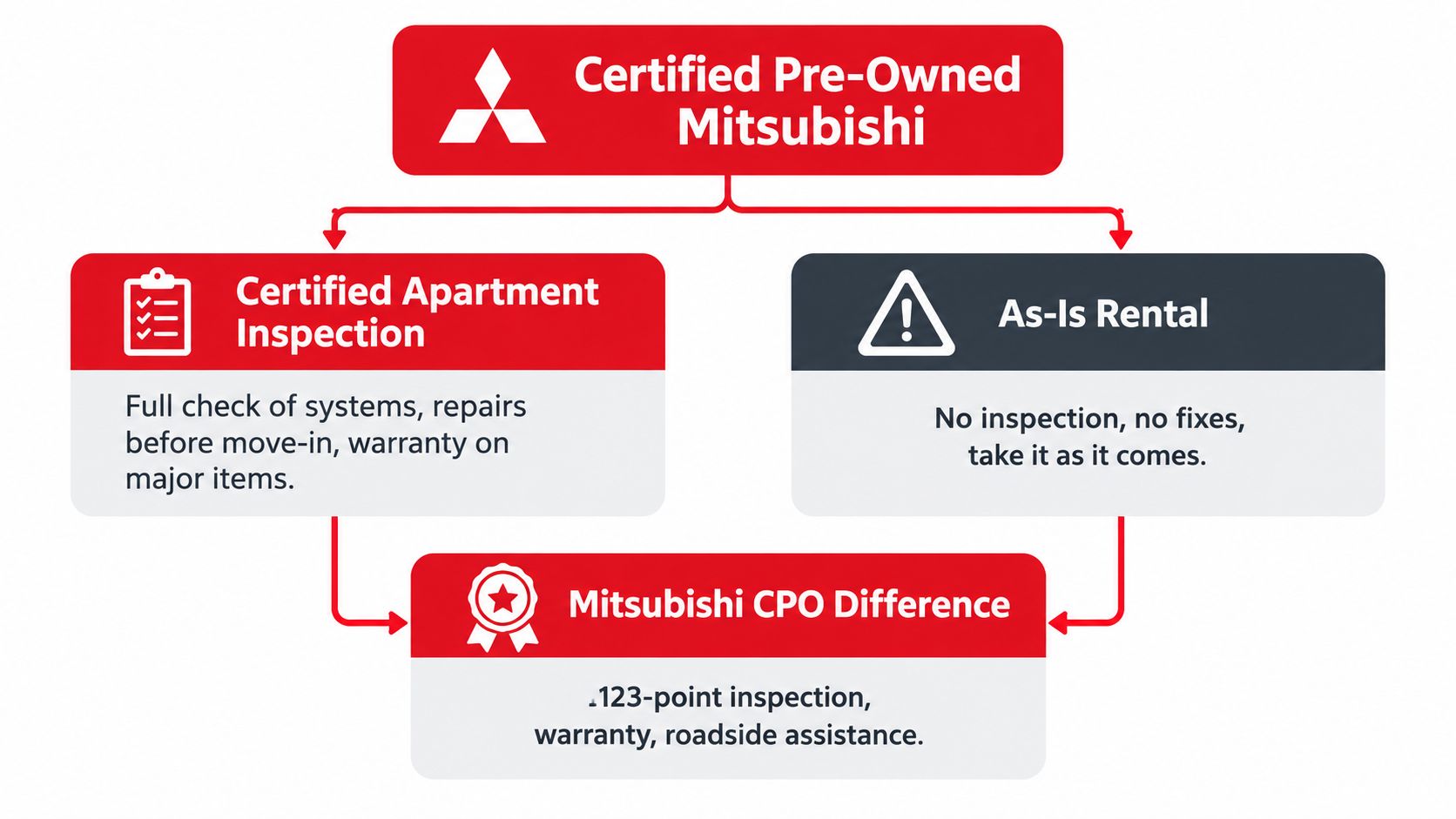
What Certified Pre-Owned Mitsubishi Really Means
Think of CPO like renting an apartment that has already passed a careful inspection, not one where you’re told to deal with whatever you discover after move-in. You’re not just buying a car that looks decent on the outside. You’re buying one that has gone through a factory-backed process designed to separate the stronger candidates from the rest.
Factory-backed is not just dealer-backed
That distinction matters. A dealer can call a used car “certified” in a loose, marketing sense, but Mitsubishi’s program is tied to a specific set of standards and a technician-led review. The badge means something because it’s connected to Mitsubishi Motors, an authorized dealer, and a Certified Mitsubishi Technician who checks the vehicle against the program’s requirements.
The result is a smaller pool of inventory. That’s not a drawback, it’s the point. In a city where people often shop quickly and compare multiple cars in one afternoon, scarcity can be useful because it tells you not every vehicle made the cut.
What the certification changes
Once a vehicle qualifies, the buyer gets more than a title label. The car has already passed through screening for history and condition, and the certification is tied to factory standards rather than a casual sales phrase. That changes the risk profile in a simple way. You’re not asking, “Does this used car look okay?” You’re asking, “Did this used car earn the right to be sold as certified?”
A good CPO process narrows the field before the sales conversation even starts.
For a New York driver, that matters because urban wear can be uneven. A car may have low annual mileage but still suffer from stop-and-go heat, repeated curbside parking, or frequent short trips that never let the drivetrain settle. CPO doesn’t erase those realities, but it does give you a more structured starting point than a random lot vehicle.
Eligibility Rules and the 123 Point Inspection Explained
The eligibility gate is where Mitsubishi CPO becomes concrete. A vehicle must be less than five years old and have fewer than 60,000 miles, then it has to pass a 123-point inspection performed by a Certified Mitsubishi Technician. Mitsubishi also requires a Vehicle History Report to screen for known accident and repair history, and the brand says not every vehicle will pass this process, which is exactly what you’d want from a serious certification standard. Mitsubishi CPO brochure
What those filters are doing
The age and mileage limits remove older, harder-driven cars before certification even begins. That matters because it keeps the CPO pool closer to the newer, lower-mileage end of the used market, which is usually where buyers feel most comfortable. The Vehicle History Report adds another layer by helping screen out vehicles with known accident or repair issues that could complicate future ownership.
The 123-point inspection is the part that gives the badge real weight. Mitsubishi says the process checks major vehicle systems, interior condition, and exterior condition before a car can be sold as certified. In plain language, the technician is looking at whether the vehicle is mechanically sound, whether the cabin shows signs of abuse or neglect, and whether the outside shows damage serious enough to raise concern.
How to read a CPO listing in the city
If you’re shopping in Long Island City or comparing online inventory before visiting the showroom, focus on the basics first. Ask how close the vehicle is to the age and mileage ceilings, whether the history report came back clean, and whether the inspection was completed by a certified technician. Those questions tell you more than a glossy photo ever will.
You can also use the inspection logic to think like a city buyer. A car with a rough history but a shiny exterior can still be a bad fit for potholes, traffic, and repeated short trips. A car that passed a strict checklist already has some of that uncertainty removed.
What shoppers should ask on the lot
- Ask about the vehicle’s age and mileage first. Those are the quickest ways to see whether a car even belongs in the CPO pool.
- Ask to review the history report. You want to understand what happened before the car was certified.
- Ask what was checked during inspection. That helps you separate cosmetic cleanup from actual vetting.
- Ask what didn’t pass, if anything was repaired. A serious certification process sometimes includes reconditioning before approval.
Useful habit: Don’t ask only whether a car is certified. Ask what it had to prove to get there.
Warranty Coverage and Roadside Protection You Keep
The warranty is where Mitsubishi CPO feels different from ordinary used-car shopping. Certified vehicles receive the remainder of a 10-year/100,000-mile limited powertrain warranty measured from the vehicle’s original in-service date, and major CPO references note $0 deductible coverage on protected repairs. That matters because the warranty is built around the expensive parts of ownership, not cosmetic annoyances or routine wear. ConsumerAffairs on Mitsubishi CPO warranty, KBB Mitsubishi CPO program
What that protection is really for
The powertrain warranty is there for engine, transmission, and driveline concerns, the kinds of failures that can turn an ordinary repair visit into a major bill. For an NYC driver, that’s especially relevant because city driving can be hard on a vehicle’s rhythm. Stop-and-go traffic, repeated low-speed operation, and frequent idling can put extra attention on the parts that move the car, not the parts you see.
Industry references also note that Mitsubishi CPO vehicles retain the remainder of the 5-year/60,000-mile new-vehicle basic warranty, and some sources say the powertrain warranty is transferable to later owners. The key point for a buyer is simple. You’re not measuring value from the day you sign, you’re measuring what coverage is left from the original in-service date.
Why the timeline matters more than the sticker
A car with a lot of life left on its original in-service clock can still offer substantial coverage even after it becomes used. That’s one reason CPO Mitsubishi vehicles can feel like a middle path. You get used-car pricing logic, but with a warranty structure that still feels anchored in the brand’s original protection model.
Coverage timing matters more than bragging rights. A later purchase date doesn’t reset the clock, the car’s original start date does.
For commuters and families, that helps reduce mental friction. You’re not wondering whether a quiet tick in traffic will become your problem tomorrow. You have a known protection window, and that makes planning easier, especially if you’re budgeting for parking, insurance, and city life all at once.
Why CPO Matters More for Outlander PHEV and Electrified Choices
The electrified angle is where CPO can become especially meaningful. A plug-in hybrid brings a different set of worries than a conventional gas SUV, and a lot of shoppers don’t know which parts of that risk are covered. Mitsubishi’s U.S. warranty documents state that the Outlander PHEV main drive lithium-ion battery is covered for defects for 10 years or 100,000 miles from the original in-service date, and CPO reporting confirms the powertrain warranty and roadside assistance framework for certified Outlander PHEVs. Outlander PHEV warranty document
Why battery coverage changes the buying question
Battery protection matters because it affects residual confidence. Buyers of used plug-in hybrids tend to think about how the battery has aged, whether charging habits were gentle or inconsistent, and what happens if they keep the car long enough to care about long-term durability. CPO doesn’t answer every battery question, but it does help reduce the uncertainty around condition and protection.
That’s especially relevant in New York, where a lot of drivers don’t put huge daily mileage on the car but do use it frequently for errands, school drop-offs, and commutes that mix traffic with short distances. A plug-in hybrid can fit that pattern well, but only if the owner feels good about the battery and the warranty framework behind it.
Range numbers that ground the conversation
| Model Year | Electric Range | Source Note |
|---|---|---|
| 2025 | 38 miles | EPA-rated all-electric range for the 2025 Mitsubishi Outlander PHEV Edmunds features and specs |
| 2026 | 44 miles | Edmunds lists a higher electric range for the 2026 model Edmunds features and specs |
| 2026 | 45 miles | Consumer Reports notes an updated electric range for 2026 Consumer Reports coverage |
The range discussion is useful because it gives the buyer a real-world frame of reference. If your daily driving is mostly local, even a modest all-electric window can shape how often you rely on gas. That said, range is only part of the picture. Battery longevity, charging cost, and resale uncertainty all sit in the background, which is why certified status can matter more here than on a traditional gas SUV.
How NYC use changes the math
For city households, the question isn’t only “How far does it go?” It’s also “How confidently can I own it?” A certified Outlander PHEV can make that answer feel cleaner because the vehicle has already passed through the CPO filters and still carries the brand’s warranty structure. That combination is what makes the electrified version especially interesting for urban buyers who want efficiency without stepping into pure EV uncertainty.
Choosing the Right Mitsubishi Model for NYC Life
The right Mitsubishi for New York depends on how you drive, not how you think you might drive once a year on vacation. A first-time buyer in Queens often wants something easier to place in tight spots, while a family in Brooklyn may care more about cargo and rear-seat flexibility. The CPO lens helps you narrow the field, but the model choice still needs to match the job.
Match the car to the routine
If your daily life is mostly commuting, school runs, and street parking, a compact, easy-to-manage Mitsubishi tends to feel less stressful than something oversized. If your weekends involve family gear, groceries, and strollers, the Outlander or Eclipse Cross can make more sense because they’re built around more flexible space. For drivers who like the idea of electrified commuting with a backup gas engine, the Outlander PHEV sits in its own category.
The easiest way to sort this out is to start with use case, not badge. Ask yourself whether the car has to be simple to park, easy to load, or good at stretching short city trips. That’s a better filter than asking which model has the flashiest spec sheet.
A practical shopping workflow
- First-time buyer: Start with the smallest vehicle that can handle your weekly life without feeling cramped.
- Daily commuter: Prioritize easy parking, predictable ownership costs, and a cabin that stays comfortable in traffic.
- Growing family: Look for rear-seat access, cargo flexibility, and a shape that doesn’t make school pickups harder.
- Electrified driver: Compare Outlander PHEV charging habits against your actual daily route before you decide.
Northstar Mitsubishi’s research hub and Vehicle Finder Service can help narrow choices before you visit Long Island City, especially if you already know whether you’re shopping for efficiency, cargo, or plug-in hybrid driving. That kind of prep saves time on the lot and keeps the conversation focused on the vehicles that fit your life.
Best practice: Shop the model first, then shop the deal. The wrong shape is never a bargain just because it’s certified.
How to Shop CPO Smart at Northstar Mitsubishi
A smart CPO purchase in NYC starts online and ends with a careful in-person check. Before you step into the showroom, look at inventory, compare trade values, and run the numbers so you know which vehicles are worth a closer look. Northstar Mitsubishi offers a trade valuation tool, Kelley Blue Book Instant Cash Offer options, Capital One pre-qualification, and a payment calculator, so you can make the first pass from home instead of burning time in traffic.
What to verify before you sign
Once you’re on the lot, don’t let the certification badge do all the talking. Ask for the original in-service date, the remaining warranty runway, the inspection documentation, and the vehicle history report. Those four details tell you whether the car’s protection and eligibility line up with the certification story you were expecting.
It also helps to ask who handled the work behind the scenes. Factory-trained technicians and genuine OEM Mitsubishi parts matter because long-term ownership is easier when maintenance, diagnostics, and repairs stay close to the brand’s standards. That’s especially useful if you plan to keep the car through several seasons of city driving.
A simple city-buyer checklist
- Review inventory online first. That lets you sort by model and condition before you travel.
- Estimate your trade and payment early. Budget clarity makes the showroom visit calmer.
- Check the warranty timeline. The remaining coverage should match the car’s original in-service date.
- Confirm inspection paperwork. Certification should come with proof, not just a badge.
- Ask about service access. Convenient scheduling matters when your weekdays are packed.
After the purchase, service access still matters. Extended operating hours can be a real advantage for urban schedules because city drivers often need maintenance before work, after work, or between family commitments. That’s the part shoppers overlook when they focus only on the sale price.
If you want help comparing certified pre-owned Mitsubishi options with your actual NYC commute, visit Northstar Mitsubishi and start with the inventory, trade tools, and pre-qualification options that fit your schedule. You’ll be able to review CPO vehicles, check the details that matter, and make a more confident decision before you ever leave Long Island City.
0 comment(s) so far on Certified Pre-Owned Mitsubishi Guide for NYC Buyers