
Lease a Mitsubishi in NYC: Steps, Terms and Savings
You’re staring at an advertised lease payment on your phone while double-parked in Astoria, a garage quote in another tab, and no clear sense of what the car will truly cost each month. That’s the normal NYC starting point. The headline payment is only one line in the full budget. When you lease a Mitsubishi, you need the worksheet behind that payment, plus insurance, parking, tolls, fuel or charging, and the charges waiting at return.
Table of Contents
- Deciding Between a Lease and a Purchase
- How to Pre-Qualify for a Mitsubishi Lease
- Reading Lease Terms and the Money Factor
- Negotiating Price and Mileage Before You Sign
- Gas-Efficient Mitsubishi Models to Lease
- Options for Subprime and Used Mitsubishi Shoppers
- Confirm Your NYC Lease Budget Before You Sign
Deciding Between a Lease and a Purchase
Leasing fits if you want a newer Mitsubishi every two or three years, drive a predictable number of miles, and prefer a lower payment at the start. Buying fits if you drive well above a typical allowance, plan to keep the vehicle for six years or more, or want equity when payments end.
Context helps, but it doesn’t decide for you. Leases represented 25.35% of new-vehicle financing in Q2 2024, up from 21.14% a year earlier, and leased vehicles averaged $148 less per month than financed vehicles, according to Experian’s Q2 2024 leasing analysis. A lower payment isn’t the same as a lower total cost once due-at-signing charges, mileage limits, and end-of-term conditions enter the math.
Three NYC Cases
- Queens commuter, moderate miles: A compact Mitsubishi on a lease can work well if your annual driving stays comfortably inside the allowance.
- Bronx family, high miles: Heavy SUV use can erase lease savings through excess-mileage charges, so buying deserves a side-by-side run.
- Brooklyn first-time buyer, thin credit file: Run lease and loan options through pre-qualification on the same vehicle before you commit.
Practical rule: If your honest answers on miles, years you’ll keep it, cash at signing, and tolerance for a return inspection point away from leasing on more than two counts, buy new or look used.
How to Pre-Qualify for a Mitsubishi Lease
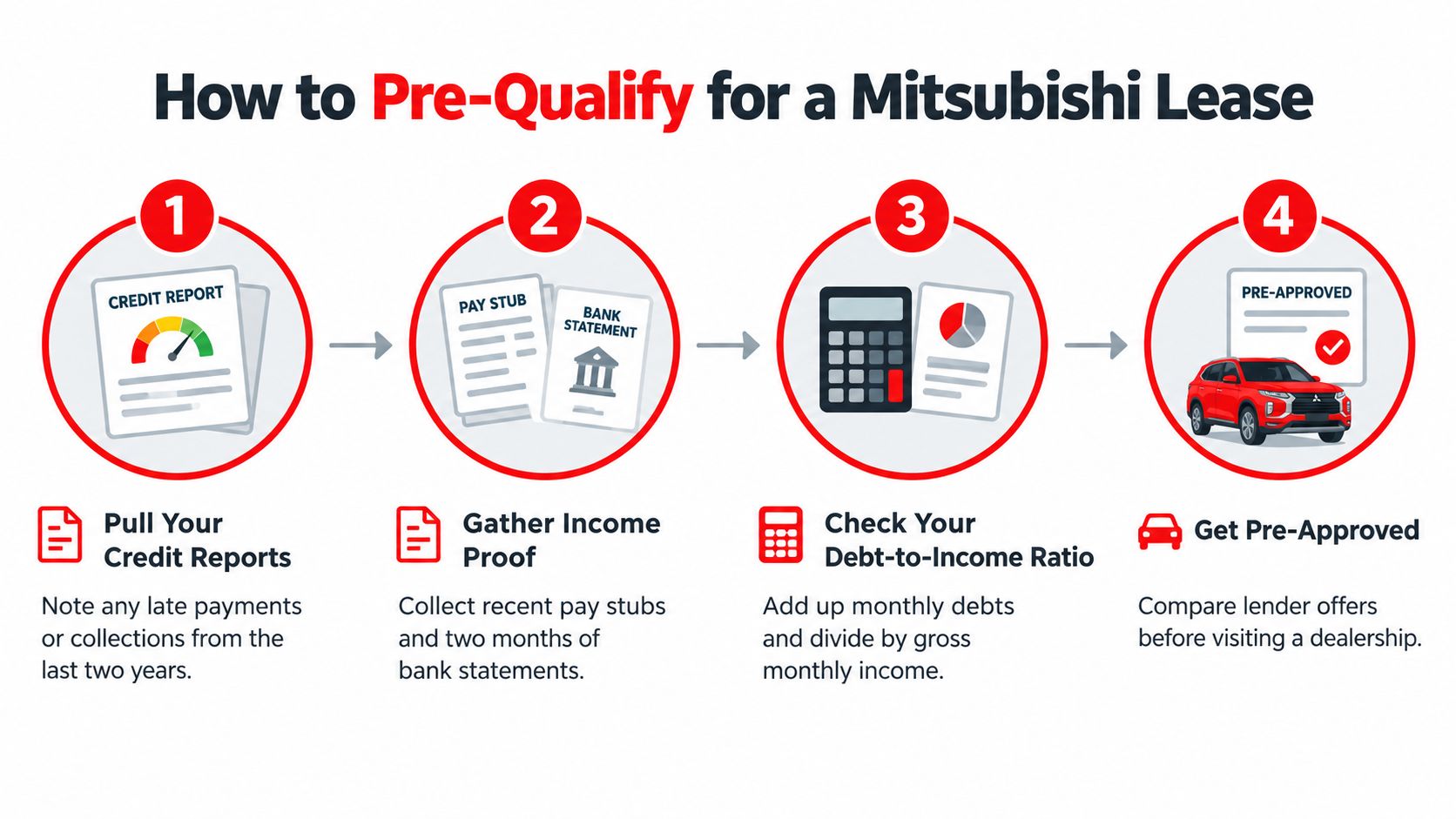
Pre-qualification tells you what terms you can likely get before you fall for a specific vehicle on the lot. Do the paperwork in this order and you’ll walk into any lease conversation knowing your range instead of guessing.
The Seven Steps
- Pull your credit reports. Note late payments and collections from the last two years, since lenders weigh recent history heavily. Don’t assume an old score you saw in an app matches what a lender pulls.
- Gather income proof. Bring recent pay stubs and two months of bank statements. If you’re self-employed, add last year’s tax return.
- Set your target payment and cash at signing. Run three different terms through a payment calculator so you can see how term length and upfront cash move the monthly figure.
- Start the secure online application. Use the finance center application or Capital One pre-qualification to see likely terms before you visit.
- Ask who receives your application. Find out which creditors may review it and what conditions could change the offer you first see.
- Compare lease against loan on the same vehicle. Use the same down payment for both so the comparison is honest.
- Bring everything to the appointment. Your pre-qualification details and documents shorten the visit and reduce surprises.
What All Credit Accepted Actually Means
All Credit Accepted invites applicants across credit profiles to apply. It doesn’t promise approval, a universal rate, or identical lease terms. Pre-approval identifies the rate, term, and maximum amount a lender is willing to offer, and the lender still makes the final decision, as the FTC guide to financing or leasing a car explains. The common slip is treating pre-qualification as final approval.
If a lender denies your application, the reasons for that adverse action can be provided through the dealer. Ask for them. That list tells you exactly what to fix before you apply again, whether it’s a balance, a recent late payment, or income documentation.
Reading Lease Terms and the Money Factor
Work every lease offer in a fixed order. Negotiate the selling price first, confirm term and mileage second, then calculate what you’re really paying for. If a salesperson wants to start with the monthly payment, slow the conversation down.
The Worked Example
The adjusted capitalized cost is the negotiated price after incentives and any capitalized-cost reduction. The residual value is what the lessor expects the vehicle to be worth at lease end. Your monthly depreciation charge is adjusted cap cost minus residual, divided by the number of months.
Take a $30,000 adjusted cap cost with an $18,000 residual over 36 months. That’s $12,000 divided by 36, or $333.33 a month in depreciation. The rent charge is the financing piece. Add cap cost and residual, then multiply by the money factor. Here, $48,000 times 0.00125 equals $60. Your base payment is $393.33 before tax and fees. That’s the math behind every advertised number, as the Edmunds lease calculator methodology lays out.
Residuals for many 36-month leases fall roughly between 45% and 60% of original value, and a higher residual generally lowers your payment because you’re financing less depreciation. Convert any money factor to an approximate annual rate by multiplying by 2,400. A money factor of 0.00125 is roughly 3.0%.
| Money factor | Approximate annual rate | Monthly rent charge at $30,000 cap cost and $18,000 residual |
|---|---|---|
| 0.00125 | 3.0% | $60 |
| 0.00200 | 4.8% | $96 |
| 0.00250 | 6.0% | $120 |
What a Usable Worksheet Shows
Ask for every line in writing: MSRP, negotiated price, incentives, capitalized-cost reduction, residual percentage and dollar amount, money factor, term, annual mileage, taxes, and every fee. If any line is missing, you can’t verify the payment.
Watch for three pitfalls. Excessive upfront fees rolled into the cap cost raise both depreciation and rent charge. Acquisition and disposition fees get overlooked because they sit at opposite ends of the contract. And comparing two offers with different mileage limits or different cash due at signing tells you nothing. Taxes, registration, and lease rules also vary by location, so confirm the NYC figures locally rather than copying an example from another state.
A payment you can’t rebuild from cap cost, residual, and money factor is a payment you shouldn’t sign for.
Negotiating Price and Mileage Before You Sign
Negotiate in sequence and mileage stops being a surprise bill three years from now. Price first, miles second, paper trail throughout.
The Negotiation Sequence
- Negotiate the selling price before discussing monthly payment. Then ask which Mitsubishi lease cash or loyalty rebates apply to you and whether they can combine.
- Estimate your real annual miles. Add your commute, weekend trips, and any move you might make during the term. Use last year’s odometer readings if you have them.
- Compare buying miles upfront against paying later. A higher allowance costs more monthly but can cost less overall.
- Get the details in writing. You want the per-mile overage rate, disposition fee, and wear standard on paper before you sign, not at return.
- Compare offers only on matching terms. Mileage, term, and cash due at signing must match across every quote.
Typical allowances run 10,000 to 15,000 miles a year, and excess-mileage charges commonly run $0.15 to $0.25 per mile, so 4,000 extra miles can cost $600 to $1,000 before wear charges, per Federal Reserve consumer leasing guidance. Extra miles reduce expected end-of-term value because residuals assume the use stated in the contract. Buying additional miles later only pays when the price sits below the per-mile penalty you’d otherwise owe.
| Allowance per year | Actual driving per year | Overage over 36 months | Charge at $0.15 per mile | Charge at $0.25 per mile |
|---|---|---|---|---|
| 10,000 | 12,000 | 6,000 | $900 | $1,500 |
| 12,000 | 16,000 | 12,000 | $1,800 | $3,000 |
| 12,000 | 15,000 | 9,000 | $1,350 | $2,250 |
| 15,000 | 12,000 | 0 | $0 | $0 |
NYC adds its own wear pattern. Stop-and-go driving, parking dings, wheel rash from tight curbs, and windshield chips all show up at inspection. Walk the car against the lessor’s standard several months before return, because handing back the keys doesn’t end your exposure to excess wear, disposition charges, or unpaid taxes.
Gas-Efficient Mitsubishi Models to Lease
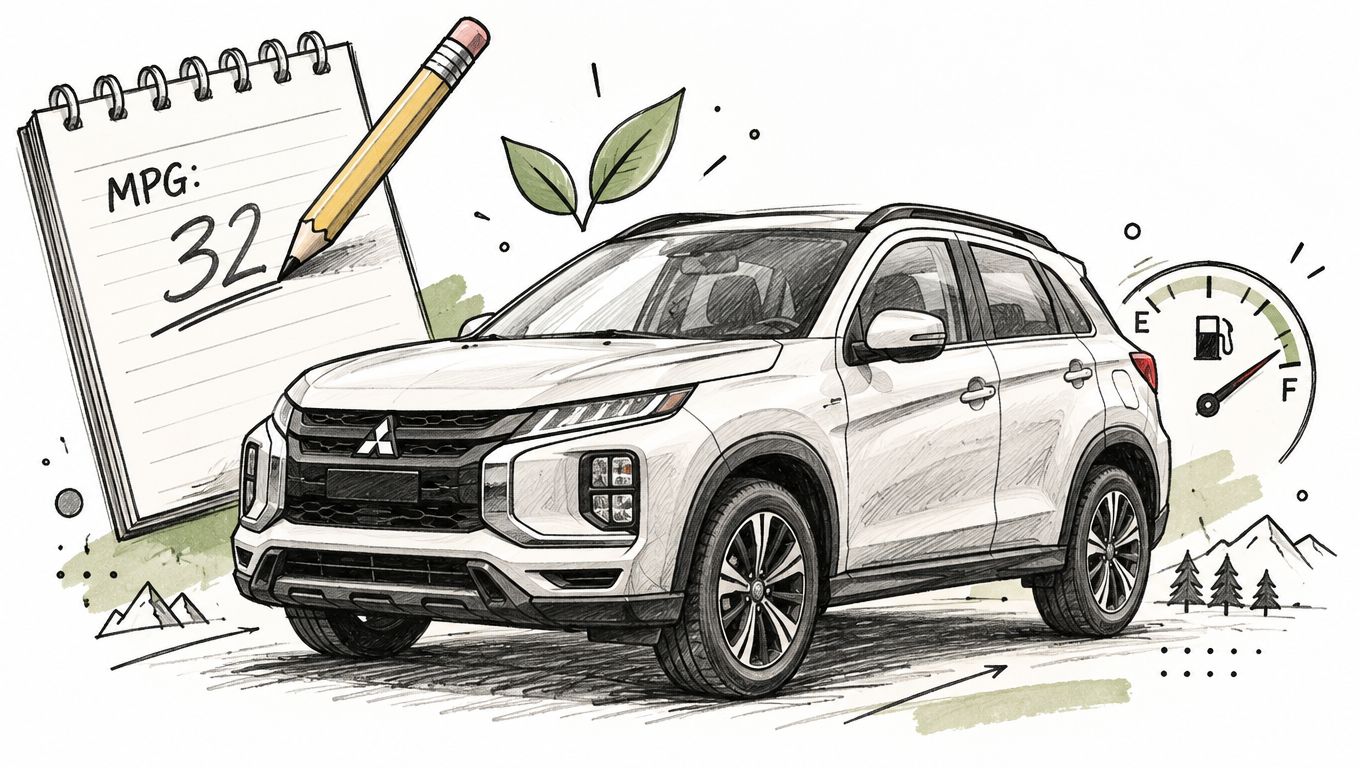
For a Queens commute, the advertised lease payment is only part of the cost. Fuel use depends on the exact model year, drivetrain, and trim, so check the EPA rating for the vehicle you plan to lease before estimating your monthly total.
Look Up the Rating Before You Shop
- Search by configuration. On fueleconomy.gov, select the model year, drivetrain, and trim you are considering. For plug-in hybrids, check the relevant powertrain details as well.
- Record all three ratings. Write down the combined, city, and highway MPG for that configuration. Add the annual fuel-cost estimate to your budget worksheet.
- Allow for local driving. EPA ratings come from laboratory tests. Traffic, cold weather, air conditioning, cargo, and tire pressure affect real-world consumption. Stop-and-go NYC trips can produce different results from the published rating.
| Model | Body style | Best use | EPA combined MPG | Lease check |
|---|---|---|---|---|
| Mirage | Subcompact hatchback | City commuting and tight parking | Look up by model year, drivetrain, and trim | Confirm current availability |
| Outlander Sport | Compact crossover | Daily driving with some cargo | Look up by model year, drivetrain, and trim | Compare ratings by trim |
| Eclipse Cross | Compact SUV | Mixed city and highway driving | Look up by model year, drivetrain, and trim | Check drivetrain-specific ratings |
| Outlander | Midsize SUV | Families and longer commutes | Look up by model year, drivetrain, and trim | Confirm engine and drivetrain |
| Outlander PHEV | Plug-in hybrid SUV | Gas-plus-electric commuting | Look up by model year, drivetrain, and trim | Record electric and gasoline figures separately |
Use the table to shortlist vehicles, then enter the exact configuration on fueleconomy.gov and record its combined, city, and highway MPG. The Mirage has a subcompact body suited to city trips and tight parking; verify its rating rather than assuming it leads on fuel economy. The Outlander Sport and Eclipse Cross offer more cargo room for daily driving, while the Outlander may better suit families and longer commutes. For the Outlander PHEV, track electric use and gasoline consumption separately so the worksheet reflects how you expect to drive.
Add fuel to the lease worksheet alongside the advertised payment, cash due at signing, and other recurring costs. Then check current inventory and match the available trim to the EPA entry you recorded. A rating for a different model year or drivetrain may not describe the vehicle on the dealer’s lot.
Options for Subprime and Used Mitsubishi Shoppers
A Queens commuter approved for a new Mitsubishi lease may still face a large upfront payment or a monthly bill that strains the budget. Compare concrete alternatives before signing: ask whether a qualified co-signer changes the lease terms, check a credit-union loan for a used Mitsubishi, and price a larger down payment against the cash you need to keep available.
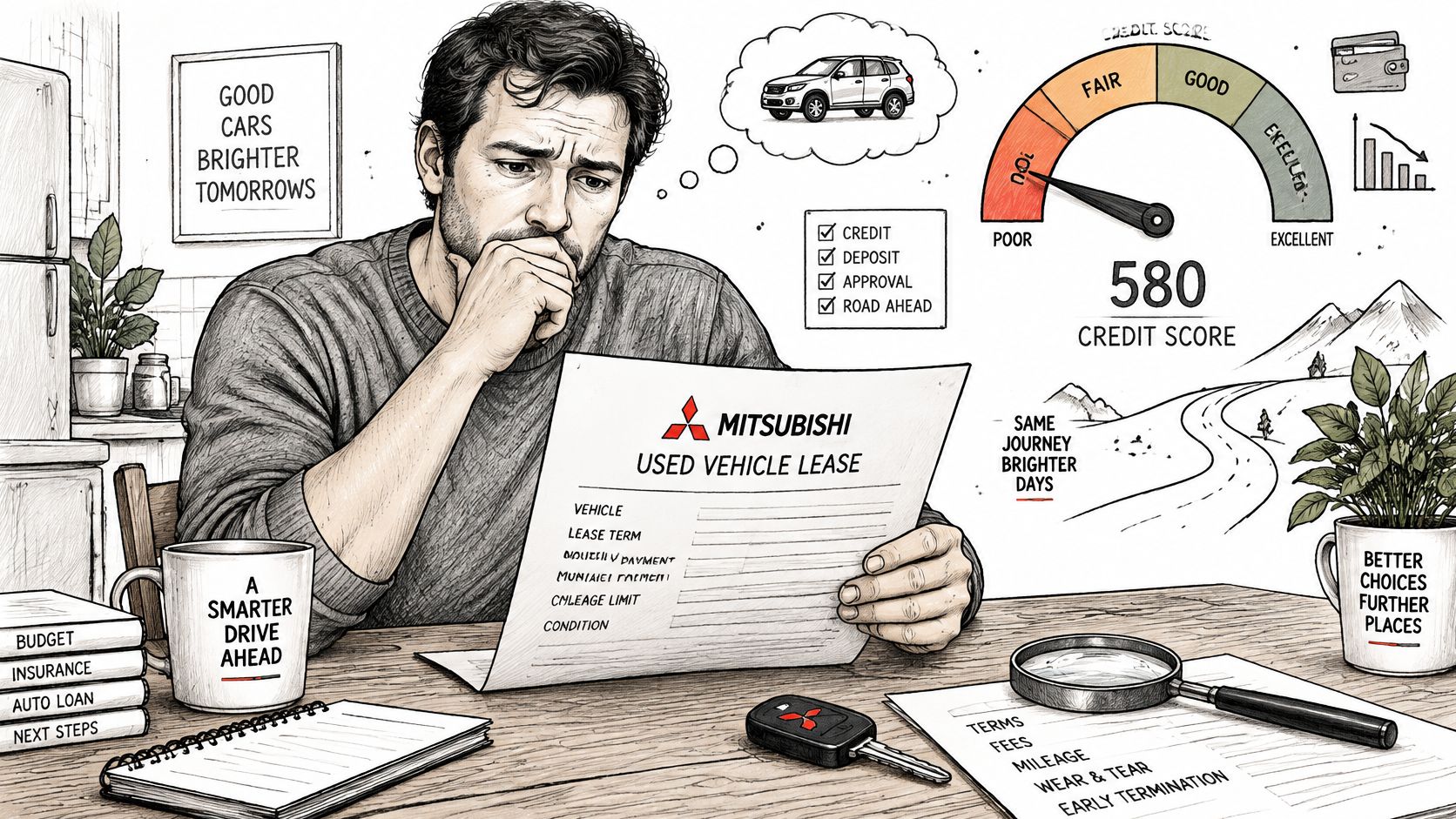
A subprime borrower has a credit score significantly below average and may receive less favorable financing terms. The CFPB report describes subprime auto lending, including delinquency in its sample, but that figure is not a lease-specific forecast for your application. Use the report for context, not as a prediction of whether a particular lease will be approved or affordable: the CFPB subprime auto lending data point.
Compare the Paths, Not Just the Payments
Ask the dealer to quote the lease with and without a co-signer, and list the required cash at signing. Separately, request a credit-union loan estimate for a used Mitsubishi, including APR, term, fees, and total payments. A shorter used-car loan can raise the monthly amount while reducing how long interest accrues. A bigger down payment can lower the borrowed amount, but leaves less cash for insurance, repairs, and other costs.
For a direct comparison, suppose a used Mitsubishi costs $18,000 before taxes and fees, and you put $3,000 down. The remaining $15,000 is the starting loan balance, before interest and added charges. Compare the lender’s full-term payment total with the lease’s payments, upfront costs, and any end-of-lease charges. Those figures must come from your actual offers; the example does not establish that buying costs less.
Get certified pre-owned inspection and warranty terms in writing, and include any down payment or trade-in credit only once in your calculation. The payment is one part of the decision. Check the total cash required and whether the monthly amount still leaves room for routine expenses.
Confirm Your NYC Lease Budget Before You Sign
A Queens commuter may see the same advertised payment as a Bronx driver, but the borough costs can change the deal. Build your all-in monthly figure before comparing offers. A quoted payment may leave out tax, title, registration, insurance, maintenance, excess wear, and acquisition or disposition fees. One current Outlander PHEV offer lists a $0.25-per-mile excess-mileage charge and a possible $395 disposition fee in current Outlander PHEV lease offer details. Approval, credit tier, insurance, and vehicle availability can also affect the offer.
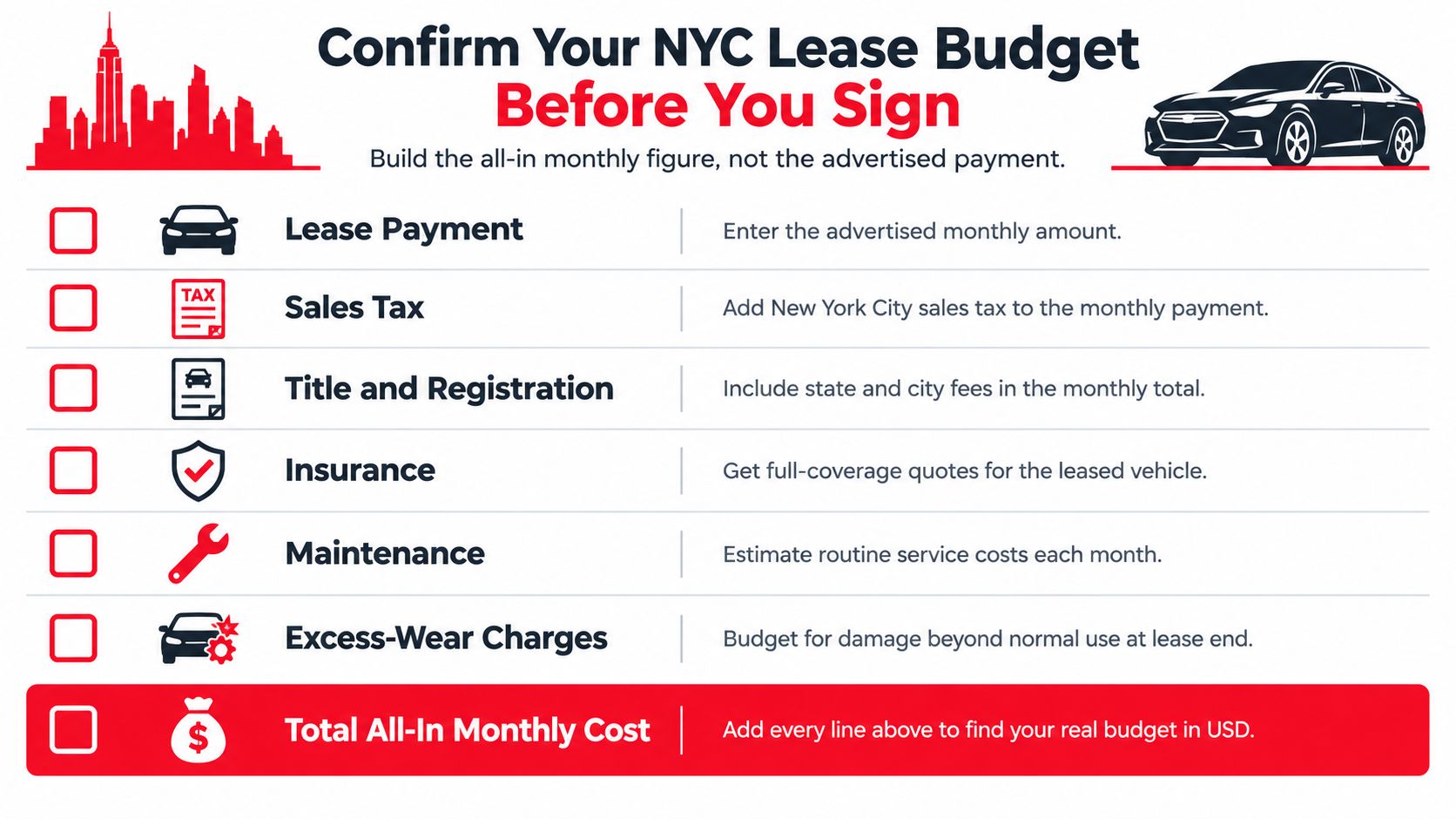
| Cost item | Where to get the figure | Your monthly amount |
|---|---|---|
| Lease payment | Worksheet rent charge plus depreciation | Enter your quoted payment |
| Tax, title and registration | Dealer quote, spread monthly | Enter your monthly share |
| Insurance | Insurer quote for the leased trim | Enter your quoted premium |
| Maintenance | Mitsubishi maintenance schedule | Enter your monthly estimate |
| Excess wear and fees | Lease contract, spread over the term | Enter your monthly reserve |
| Parking | Building or street parking rules | Enter your monthly cost |
| Tolls and congestion charge | Regular routes and MTA charges | Enter your monthly total |
| Charging or fuel | Miles times efficiency times price | Enter your monthly estimate |
Fill in the worksheet with quotes for the exact vehicle and your actual routes. Garage parking in the Bronx and street parking for a Queens household can produce very different totals, even when the lease payment matches. Include tolls, congestion charges, and parking rather than treating them as occasional extras.
For a plug-in hybrid, compare three charging situations: reliable home charging, occasional public charging, and no dependable charging. If regular charging is unavailable, you may pay for the PHEV’s extra weight and cost without getting much electric driving. A gasoline model may fit that use better.
Account for the end of the lease before signing. You can return the vehicle, buy it at the preset option-to-purchase price established at signing, or replace it with another vehicle. Each choice leaves you with different exposure to wear charges, mileage bills, and market value. Your worksheet should show both the monthly cost and the likely end-of-lease costs.
Take the completed budget, mileage estimate, and questions to Northstar Mitsubishi in Long Island City. Use the payment calculator, trade-in valuation, and secure credit tools at Northstar Mitsubishi, then review the figures for the specific vehicle you want. Lease when the all-in cost fits your budget and mileage is predictable. If it does not, compare a used or certified Mitsubishi before committing.
0 comment(s) so far on Lease a Mitsubishi in NYC: Steps, Terms and Savings