
Mitsubishi Outlander vs Outlander Sport: Which Fits NYC
Smaller doesn’t automatically mean more fuel-efficient. In Autoweb’s comparison of the 2022 Mitsubishi Outlander and 2021 Outlander Sport, both front-wheel-drive models returned an EPA-rated 27 mpg combined, despite the Outlander’s greater engine output. For NYC buyers, that makes this less a simple fuel-saving decision and more a question of which vehicle makes parking, passenger loading, and everyday errands easier.
Table of Contents
- Outlander vs Outlander Sport at a Glance
- How Size Shapes Parking and Daily Life in NYC
- Engine Power and Real-World Performance
- Fuel Economy and Gas-Efficient Mitsubishi Options
- Standard Safety Features and What Testing Shows
- Pricing, Financing and Used Options to Compare
- Choose the Right Mitsubishi and Book a Test Drive
Outlander vs Outlander Sport at a Glance
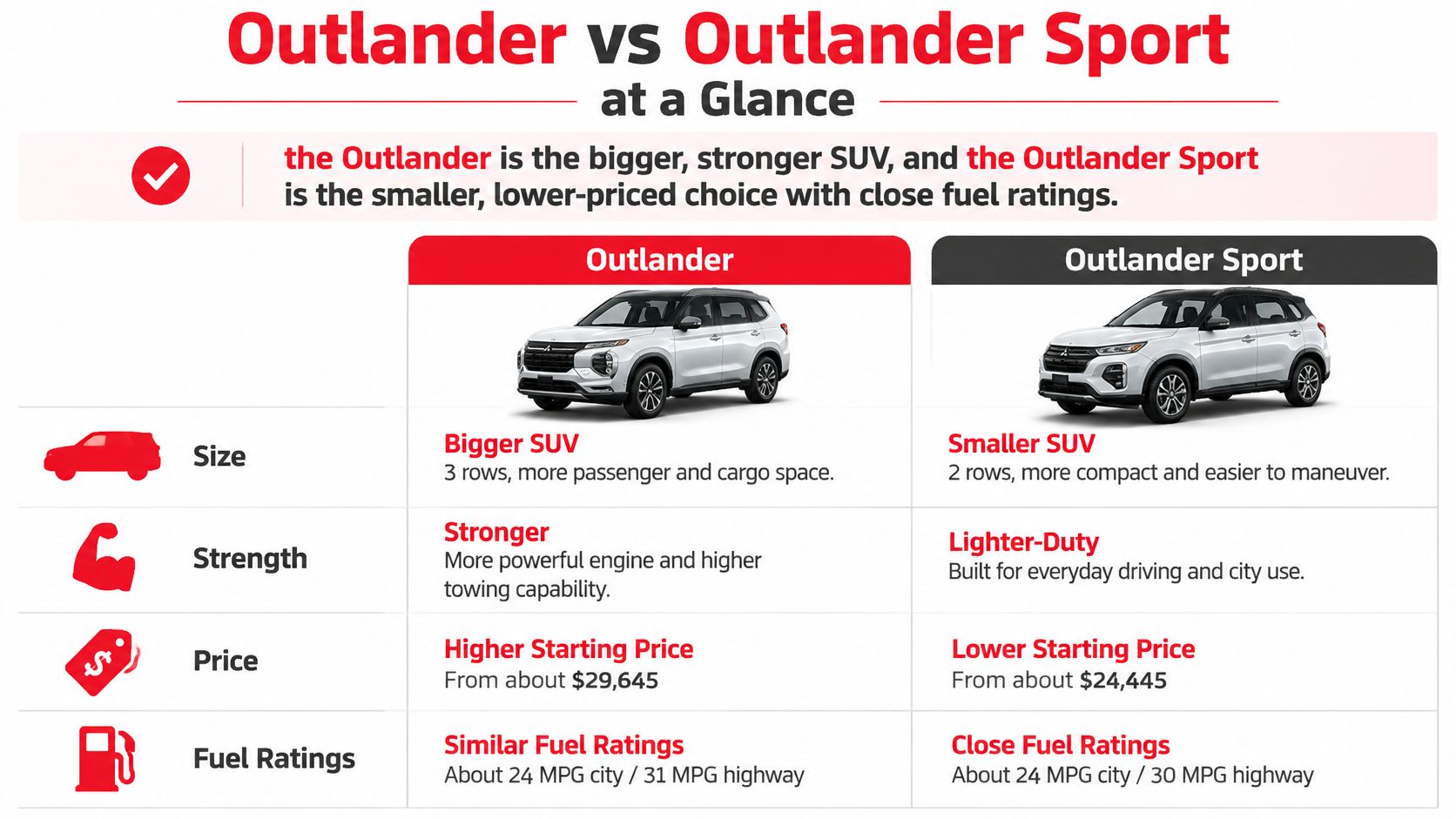
The Outlander is the bigger, stronger SUV, and the Outlander Sport is the smaller, lower-priced choice with close fuel ratings.
The Mitsubishi Outlander vs Outlander Sport comparison needs a model-year warning: the available specifications span different years, drivetrains, and reporting sources. They’re useful for narrowing your shortlist, but they aren’t a substitute for the window sticker on the actual vehicle.
Outlander and Outlander Sport specifications at a glance
| Specification | Outlander Sport | Outlander |
|---|---|---|
| Standard engine | 2.0-liter four-cylinder, 148 hp, using the 2024 specification | 2.5-liter four-cylinder, 187 hp in the 2022 comparison |
| Optional engine | 2.4-liter four-cylinder, 168 hp on 2024 SEL trims | Optional engine not established; 2025 gasoline model uses a 2.5-liter, 181-hp engine and CVT |
| Length and width | 171.9 in and 71.3 in, in the 2026 specification | Dimensions not established by the cited comparison |
| Cargo behind rear seat | 21.7 cu ft | 31 cu ft behind second row, 11 cu ft behind third row, for 2025 |
| Cargo with seats folded | 49.5 cu ft | 64 cu ft behind front row, for 2025 |
| Seating | Five seats, per the 2025 brochure | Three rows, for 2025 |
| EPA combined mpg, front-wheel drive | 27 mpg in the older comparison and selected 2025 brochure entries | 27 mpg, for 2022 |
| Starting price, 2025 model year | $26,230; SEL $31,230 | Confirm the vehicle’s window sticker |
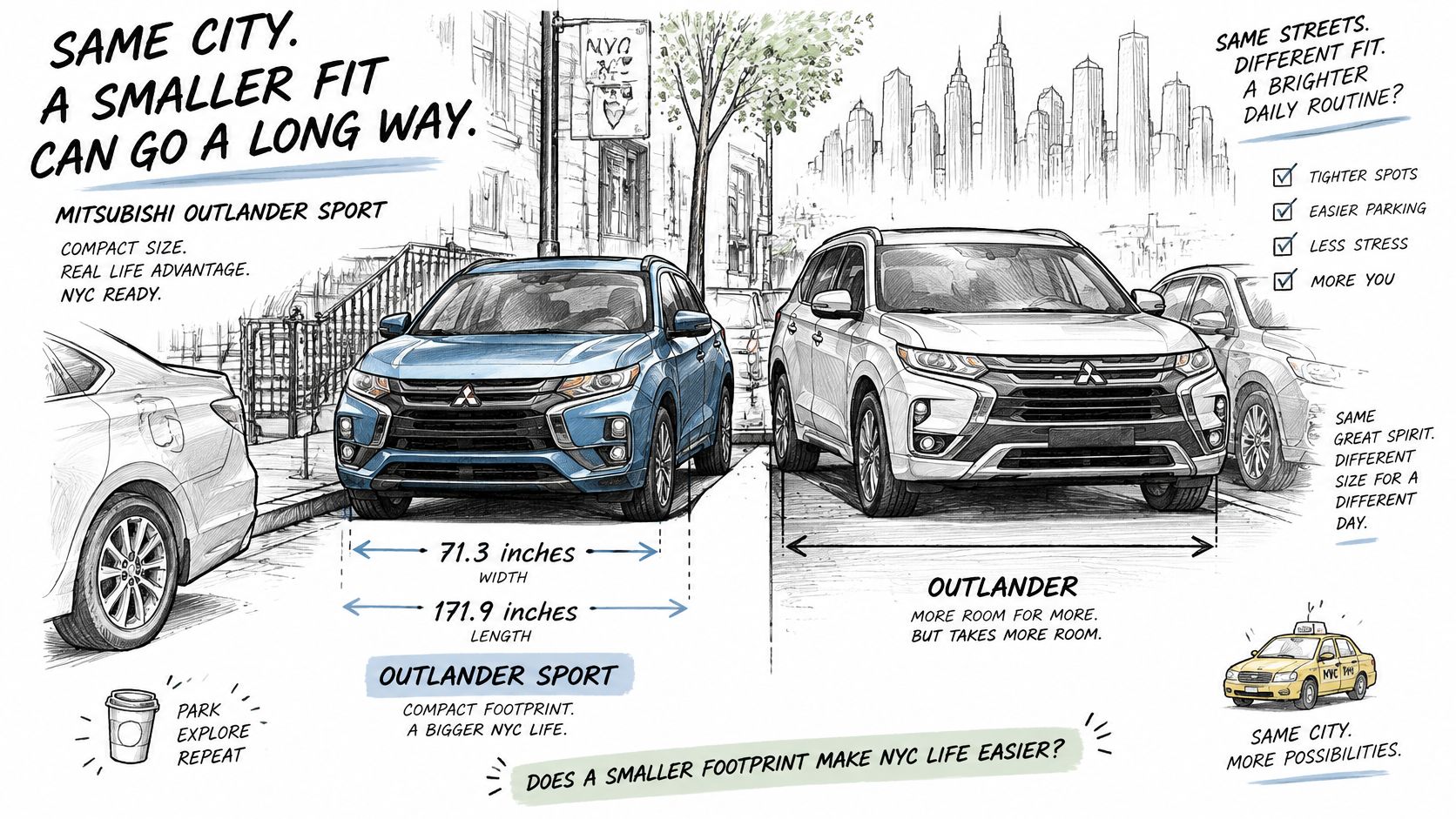
The Sport’s dimensions and cargo measurements come from Kelley Blue Book’s 2026 Outlander Sport specifications, which list 171.9 inches long, 71.3 inches wide, and 21.7 or 49.5 cubic feet of cargo space, depending on seat position. The table’s other model-year-specific figures are addressed with their respective engine, fuel-economy, and pricing sources below.
Start With the Space You Actually Need
Don’t pay for passenger flexibility you won’t use, but don’t underestimate how often you carry bulky items. A smaller vehicle that requires repeated cargo rearranging may be less convenient than a larger one that takes more care to park.
Your first decision is therefore straightforward: do you need an additional seating row, or is a compact footprint more valuable? Treat that as a starting hypothesis, then test it against your parking space and normal load.
How Size Shapes Parking and Daily Life in NYC
Does the Sport’s smaller footprint make NYC life easier, or does it merely look convenient on a specification sheet? The answer comes from the spaces you use, not the vehicle’s name.
Its exterior dimensions establish a compact starting point, but they don’t establish turning-circle superiority, mirror clearance, or visibility. Comparable Outlander dimensions and measured parking tests aren’t available here, so a precise claim about how much easier the Sport parks would go beyond the evidence.
Test the Tasks Separately
- Curbside gaps: Try a legal space representative of your neighborhood. Notice whether you can judge the bumpers confidently rather than relying on repeated corrections.
- Busy-avenue parallel parking: Watch the front corner as the rear enters the space. Body length alone doesn’t tell you how confidently you’ll manage the swing toward passing traffic.
- Garage entry: Measure the narrowest opening, including columns and protective barriers. Then check mirror clearance, ramp transitions, and whether you can open the driver’s door after parking.
- Rear-seat access: Bring your actual child seat. Test the rear-door opening and the movement needed to buckle a child without leaning awkwardly from the sidewalk.
A garage-fit check should include more than whether the vehicle crosses the entrance. You still need room to unload groceries, access a child seat, and reach the liftgate without striking a wall or low obstruction.
Parking rule: A vehicle fits your garage only if you can park it, get out, and unload it comfortably.
Cargo Is a Different Question
Say your daily load is a stroller and grocery bags. The Sport may accommodate that comfortably, but stroller shape, wheel placement, and the load-floor opening matter more than a cargo-volume total.
A household using three child seats shouldn’t assume the Outlander solves the problem automatically. Bring every seat, verify approved seating positions in the owner’s manual, and check whether the required arrangement leaves usable access to the rear.
The Outlander’s additional row is best treated as accommodation for children or occasional short trips, not an adult-comfort guarantee. Airport duty also requires a separate luggage test with the seats arranged for everyone traveling.
For a useful street test, parallel park on both sides of a block where legal, measure your garage opening and door clearance, and load a stroller plus two grocery bags into each vehicle. Record what required awkward lifting or extra maneuvering. That’s the ownership difference you’ll notice repeatedly.
Engine Power and Real-World Performance
The Outlander offers more power; the Sport’s smaller standard engine is better approached as an everyday commuter powertrain than a promise of quick acceleration. However, lower output alone doesn’t prove lower fuel consumption.
For the 2024 Outlander Sport, Kelley Blue Book reports 148 horsepower from the standard engine and 168 horsepower from the SEL’s 2.4-liter engine. The larger engine gives buyers a higher-output Sport option, but it doesn’t turn the vehicle into the larger Outlander.
The older Outlander comparison uses a different engine rating from the later vehicle. Don’t interpret that difference as a measured performance decline: horsepower specifications from different model years aren’t a controlled acceleration test.
What the Extra Output Means on Your Route
For the 2025 Outlander, Car and Driver’s road test reports a 2.5-liter engine producing 181 horsepower and 181 lb-ft through a CVT, an 8.5-second run to 60 mph, and 30 mpg in its highway test; it also lists cargo capacity at 64 cubic feet behind the front row, 31 behind the second, and 11 behind the third.
On a Cross Bronx Expressway entrance ramp, evaluate whether the vehicle builds speed without making you feel rushed into a gap. On the Long Island Expressway, assess passing response only when conditions permit, including the delay between pressing the accelerator and getting useful acceleration.
Passenger load deserves its own test. Climbing a grade with adults aboard or taking a loaded trip across the George Washington Bridge can expose a powertrain’s limitations more clearly than an empty-car drive around the block.
- Solo commuting: Judge smoothness, response from low speed, and whether engine noise bothers you during ordinary acceleration.
- Frequent passenger trips: Test with a representative load where practical. More output can help, but vehicle weight and transmission behavior also affect the result.
- Choosing the upgraded Sport engine: Ask whether the improvement addresses your actual merge or hill-climbing concern rather than buying it solely for the badge.
The Sport’s comparable acceleration time isn’t established by these sources. That prevents a defensible stopwatch-based claim about how much slower it is.
For short crosstown trips and stop-and-go driving, modest output may be entirely acceptable. Finish your evaluation with a highway merge and a hill, because an easy neighborhood loop won’t answer the important performance questions.
Fuel Economy and Gas-Efficient Mitsubishi Options
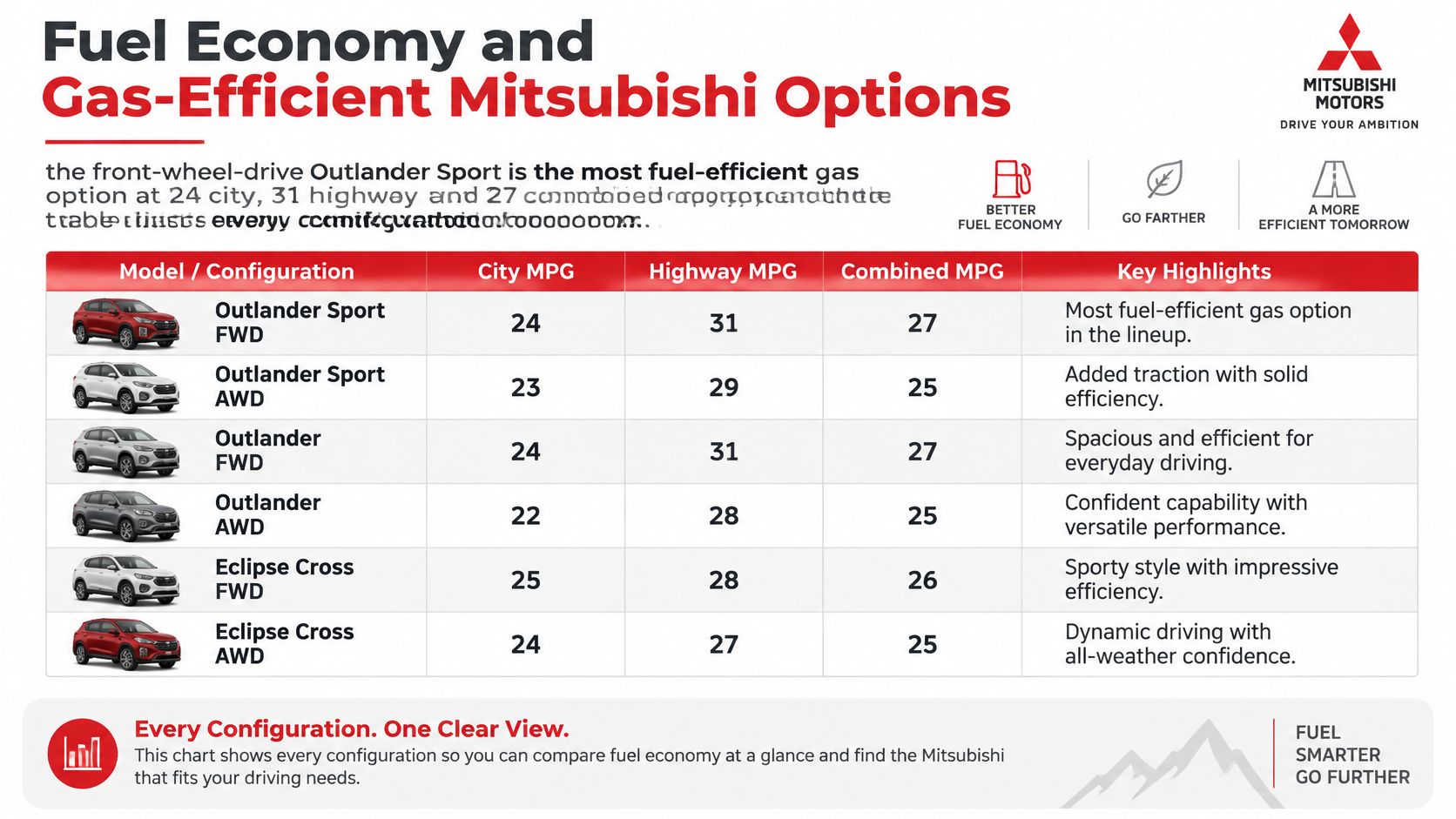
The front-wheel-drive Outlander Sport reaches 24 city, 31 highway, and 27 combined mpg in selected entries in Mitsubishi’s 2025 Outlander Sport brochure, which also lists 24/30/26 mpg for specified S-AWC configurations. That makes it a fuel-efficient gasoline option, but not a proven outright winner over every Outlander configuration.
The distinction matters because the older front-drive Outlander carries matching ratings. Choose between these vehicles using the correct year and drivetrain, not an assumption that smaller always saves fuel.
Fuel economy by configuration (mpg)
| Configuration | Model year and source | City | Highway | Combined |
|---|---|---|---|---|
| Outlander Sport 2.0L front-wheel drive | 2025 Mitsubishi brochure entries | 24 | 31 | 27 |
| Outlander Sport 2.0L 4WD, S-AWC | 2024 EPA rating | 23 | 29 | 26 |
| Outlander Sport 2.0L | 2025 Car and Driver ratings | 23 | 29 | Not stated |
| Outlander Sport 2.4L | 2025 Car and Driver ratings | 23 | 28 | Not stated |
| Outlander 2.5L front-wheel drive | 2022 Autoweb comparison | 24 | 31 | 27 |
| Outlander 2.5L all-wheel drive | 2022 Autoweb comparison | 24 | 30 | 26 |
| Outlander PHEV | Current U.S. EPA figures not established |
The EPA’s 2024 model listing gives the 2.0-liter Outlander Sport 4WD 23 mpg city, 29 highway, and 26 combined. For 2025, Car and Driver’s Outlander Sport guide lists 23/29 mpg for the 2.0-liter and 23/28 for the 2.4-liter, and reports 25 mpg in a 75-mph highway test of an all-wheel-drive model.
Why the Ratings Don’t Line Up Perfectly
These entries describe different model years and drive configurations. The brochure and editorial listings also don’t align cleanly enough to assign every figure confidently to every vehicle on a sales lot.
Use the actual window sticker as the final comparison document. Don’t average conflicting listings, and don’t calculate an official combined rating from city and highway figures.
A highway test isn’t a promise for Queens traffic. Idling, repeated cold starts, weather, load, and driving speed can change consumption.
Range, Fuel Budgets, and Charging
As an illustrative calculation using the listed tank capacity and ratings, a 15.8-gallon tank at 29 mpg suggests about 458 miles; at 26 mpg, about 411 miles. Those are mathematical estimates, not recommended distances between fill-ups.
For a clearly hypothetical budget, assume 12,000 miles annually and gasoline at $3.50 per gallon. A vehicle averaging 26 mpg would use about $1,615 in fuel, versus $2,000 at a hypothetical 21 mpg, a difference of approximately $385 annually.
Compare fuel spending with financing costs before paying more for a vehicle solely to save gasoline.
The Outlander PHEV deserves consideration if reliable home charging is available and reducing gasoline use is a priority. Its current U.S. EPA figures aren’t established here, so the table leaves those cells blank rather than substituting older overseas test-cycle results. Compare electricity costs, charging access, purchase price, and your normal trip length before calling it the lowest-cost option.
Standard Safety Features and What Testing Shows
The Sport lists lane-departure warning, a pre-collision safety system, front and rear head airbags, stability control, and four-wheel ABS as standard equipment in Edmunds’ 2026 Outlander Sport feature listing. That equipment list isn’t a crash-safety rating.
The larger Outlander shouldn’t receive an automatic safety victory just because it offers more cabin space. Conversely, a smaller vehicle’s easier placement in traffic doesn’t prove better occupant protection in a collision.
Separate Equipment From Crash Evidence
The available safety notes describe an incomplete IIHS small-overlap result for the earlier Sport model year, but a directly linked IIHS report isn’t available here. That limitation prevents a firm comparison based on that result; don’t interpret incomplete coverage as either a pass or a failure.
Small-overlap crashes involve the vehicle’s front corner rather than a broad, centered impact. Structural design and occupant restraint performance matter, so a list of electronic warnings can’t answer the same question.
Use a matched-year checklist:
- Confirm the exact trim: Identify which driver-assistance systems are standard, optional, or absent on the vehicle you’re considering.
- Check independent testing: Look up IIHS and NHTSA coverage for the relevant model year, including which tests were completed.
- Verify the Outlander separately: Don’t assume its equipment matches the Sport’s because both wear Mitsubishi badges.
- Install your child seat: Check approved anchor positions, front-seat clearance, and access to the buckle.
- Assess visibility: Sit in your normal driving position with the child seat installed and inspect rearward sightlines.
- Try parking aids: Confirm whether blind-spot monitoring and parking sensors are fitted, then learn their warnings during a safe demonstration.
Buy for the Whole Family’s Use
Rear-door opening angle can matter when you’re buckling a child beside a parked car. Rear visibility can also change once a tall child seat or passenger occupies the cabin.
Neither observation replaces crash testing, but both affect how comfortably you can operate the vehicle. Families and first-time SUV buyers should require documented protection and usable controls, not the longest list of warning-system names.
Pricing, Financing and Used Options to Compare
For the 2025 model year, Kelley Blue Book lists the Outlander Sport’s starting sticker price at $26,230, with the SEL starting at $31,230. Comparable Outlander starting pricing isn’t established here, so confirm it on the vehicle’s window sticker rather than relying on a guessed price gap.
Request an itemized out-the-door quote. Identify the trim, destination charge, negotiated selling price, New York sales tax, registration, and any optional products, checking that nothing is counted twice.
Protect Yourself When Buying Used
The Federal Trade Commission’s used-car buying guide says dealers must provide a Buyers Guide on used vehicles stating whether they’re sold as is or with a warranty. A certified description shouldn’t replace the actual warranty contract.
- Read the coverage: Identify covered systems, exclusions, and expiration by time or mileage.
- Identify who pays: Check responsibility for labor, parts, deductibles, and repair authorization.
- Separate the documents: A remaining manufacturer warranty, dealer warranty, and optional service contract aren’t interchangeable.
- Verify certified status: Request written confirmation of the applicable program and inspection documentation.
A used Mitsubishi can reduce the purchase amount, but condition, maintenance history, and repair exposure still belong in the budget. Arrange an independent inspection where practical rather than assuming a clean appearance proves mechanical condition.
All Credit Accepted Isn’t All Credit Approved
For subprime shoppers, all credit accepted should mean an opportunity to apply, not guaranteed approval. A lender evaluates credit history, income, existing debts, amount financed, down payment, the vehicle, and loan term.
Consider a hypothetical $20,000 loan over 60 months with no added fees: the payment is approximately $415 at 9% APR, versus $508 at 18% APR. These are illustrative amortization calculations, not advertised offers or predictions of the rate you’ll receive.
Budget safeguard: A fuel-efficient vehicle can still be expensive to own if the financing terms are unfavorable.
Compare each offer’s APR, amount financed, monthly payment, fees, down payment, and term length. A lower payment achieved by extending the term isn’t automatically a better deal.
Get a pre-qualification or payment estimate before visiting, then compare it with the final lender offer. Estimates help you shop; they don’t guarantee approval or final terms.
Choose the Right Mitsubishi and Book a Test Drive
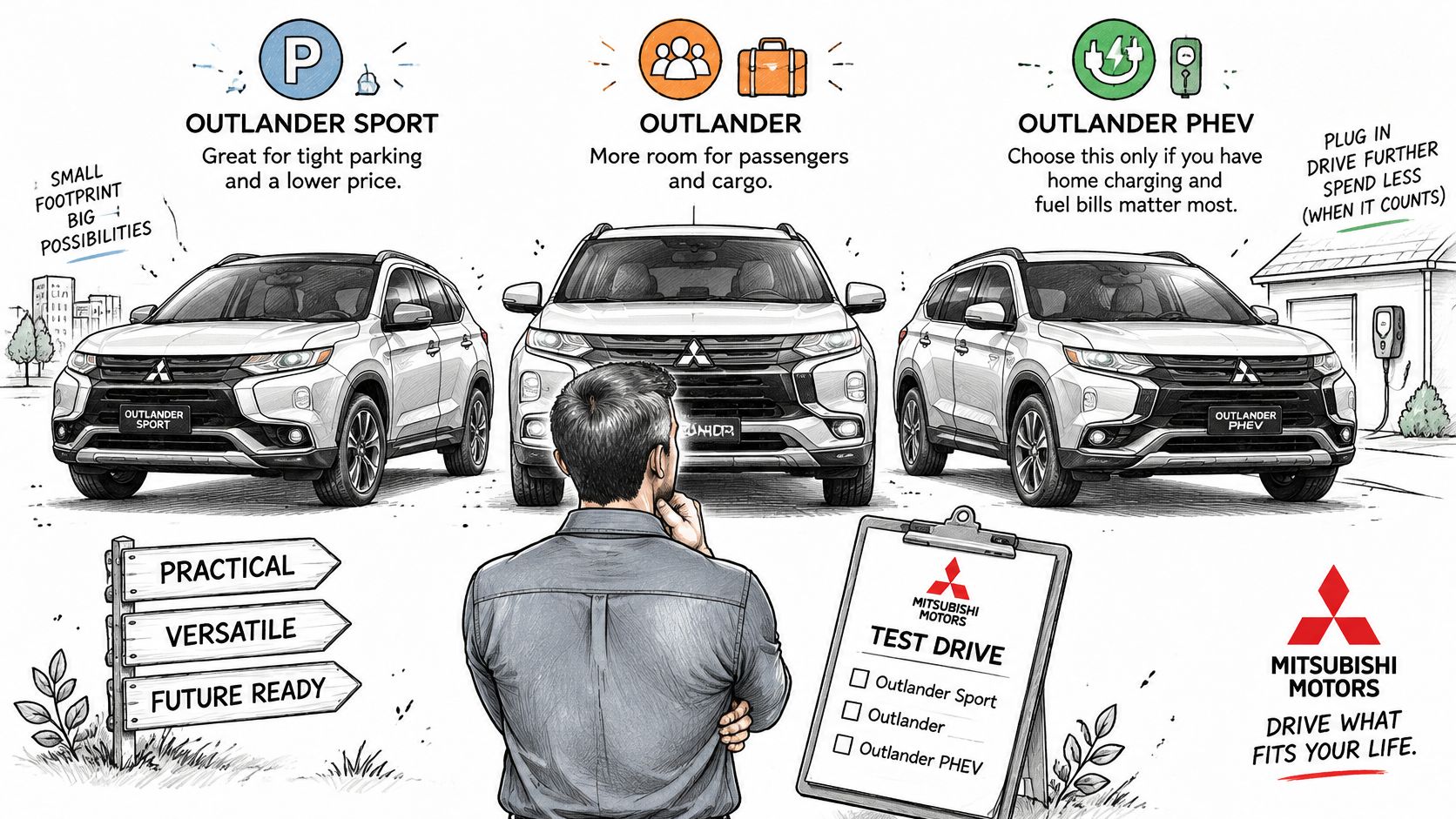
Choose the Outlander Sport when compact packaging and purchase budget dominate. Choose the Outlander when passenger flexibility and cargo loading justify a larger vehicle, and investigate the Outlander PHEV when home charging makes electric driving practical.
Those are situational recommendations, not universal rankings. Your driveway, family equipment, driving route, and financing offer can change which vehicle makes sense.
Which Mitsubishi fits which NYC buyer
| Your situation | Better fit | Main reason |
|---|---|---|
| Solo commuter with tight curb parking | Outlander Sport | Compact footprint and competitive combined fuel ratings |
| First-time buyer on a tight budget | Outlander Sport, new or used | A smaller-model starting point, subject to actual price and financing |
| Family with car seats or regular airport runs | Outlander | More cargo flexibility and an additional row suited to children |
| Frequent highway trips with passengers | Outlander | Higher output and encouraging highway-test economy |
| Lowest fuel bills with home charging | Outlander PHEV, subject to a cost comparison | Electric driving potential; confirm current pricing, range, and availability |
| Used buyer who wants warranty protection | Either model, Certified Pre-Owned | Documented coverage and inspection matter more than the badge alone |
Let Your Hardest Regular Task Decide
A compact SUV that handles your commute well but struggles with your weekly family load may be the wrong compromise. Equally, an additional seating row offers little value if you rarely use it and dislike maneuvering the vehicle into your garage.
Don’t let the occasional holiday trip outweigh every ordinary weekday without considering alternatives. Judge each model against the tasks you routinely repeat, then decide how much inconvenience you’ll tolerate for the exceptions.
Keep a short note on your phone during each drive: visibility, parking corrections, seat comfort, cargo loading, and acceleration confidence. Make those observations before discussing monthly payments, so the financing conversation doesn’t substitute for choosing the right vehicle.
Turn the Shortlist Into a Purchase Plan
- Set the budget first. Include insurance, parking, fuel or charging, and maintenance alongside the vehicle payment. Obtain an estimate before choosing a trim.
- Identify the exact vehicle. Match the model year, engine, drivetrain, window sticker, and installed feature list rather than shopping by model name alone.
- Book a Northstar Mitsubishi test drive. Drive both candidates on the same route and repeat the curb-parking, garage-clearance, and cargo-loading checks.
- Include demanding driving. Add a highway merge and a hill, using a representative passenger load where practical.
- Request used-car paperwork early. Obtain the Buyers Guide and warranty documents before negotiating, and confirm any certified status in writing.
- Review the final loan offer. Compare APR, fees, amount financed, down payment, and term with your estimate before signing.
The right choice is the Mitsubishi that passes your real-life checks without stretching the budget. Neither the smaller footprint nor the larger cabin deserves a premium unless it solves a problem you have.
Northstar Mitsubishi offers new Mitsubishi models, used and certified pre-owned options, and online credit pre-qualification tools for NYC shoppers comparing these SUVs. Visit Northstar Mitsubishi to review available vehicles and arrange a back-to-back test drive with your parking measurements and everyday cargo.
0 comment(s) so far on Mitsubishi Outlander vs Outlander Sport: Which Fits NYC