
Used Cars Mitsubishi Mirage: Smart Buying Guide for 2026
You’re standing on a lot in Queens, staring at a used Mirage with a price that looks almost suspiciously low. The car is tiny, easy to park, and probably cheaper to fuel than almost anything else you’ll find. But then the doubts kick in. Is it too slow for the LIE? Is the CVT a problem? Did Mitsubishi killing it off in the U.S. make it a bargain or a trap?
That’s the right moment to slow down.
I’ve walked plenty of NYC buyers through this exact decision, and the Mirage always splits the room. Some people see a smart commuter. Others see the cheapest car of its era and assume that means compromise everywhere. It’s simpler. A used Mitsubishi Mirage can be a very smart buy if you target the right years, pick the right body style for your routine, and inspect it like a city car that’s lived a city-car life.
Table of Contents
- A Smart Buyer’s First Look at a Used Mirage
- How the Mirage Nameplate Shapes Today’s Used Market
- Body Styles and Trims Worth Considering
- Powertrain, MPG, and Common Mechanical Issues
- Reliability, Recalls, and Long-Term Durability
- Why Discontinuation Changes the Deal in 2026
- Inspection and Financing Tips for NYC Shoppers
- Is a Used Mitsubishi Mirage the Right Fit for You
A Smart Buyer’s First Look at a Used Mirage
A Mirage makes sense in New York for reasons that have nothing to do with impressing anybody. It fits in miserable curbside spots. It’s light, simple, and cheap to run. The hatchback especially works well for buyers who need one car to do weekday commuting, grocery runs, and alternate-side-parking duty without drama.
The mistake buyers make is treating every used Mirage like the same car. They’re not. A launch-era car and a final-run car can feel very different in features, refinement, and drivability. The Mirage also has a long nameplate history, originally built from 1978 to 2003 and then revived in 2012, which matters because it gives the model a long service and parts trail, but it also means the model year matters a lot when you shop the used market, as outlined in the Mirage nameplate history and sales background.
The four decisions that actually matter
When I’m advising a buyer on used cars Mitsubishi Mirage shopping, I focus on four calls:
- Model-year target: Older cars can be cheap, but later cars usually make more sense if you want better features and less wear.
- Hatchback or G4 sedan: The right answer depends on whether you street-park, carry cargo, or want a separate trunk.
- Engine and transmission behavior: The 1.2-liter three-cylinder is rated at 78 horsepower and 74 lb-ft of torque, so you need realistic expectations about acceleration and highway merging, based on Kelley Blue Book Mirage specs.
- Post-discontinuation value: Since Mitsubishi ended U.S. Mirage production after 2024, used supply and resale dynamics changed.
Practical rule: If you need a cheap borough commuter and you rarely ask your car to do fast highway work with four adults onboard, the Mirage deserves a real look.
If you want one car for constant Parkway sprints, loaded family duty, and effortless passing power, skip it. That’s not what this car is for. The smart buyer wins with a Mirage by buying it for the job it does well, not the one they wish it did.
How the Mirage Nameplate Shapes Today’s Used Market
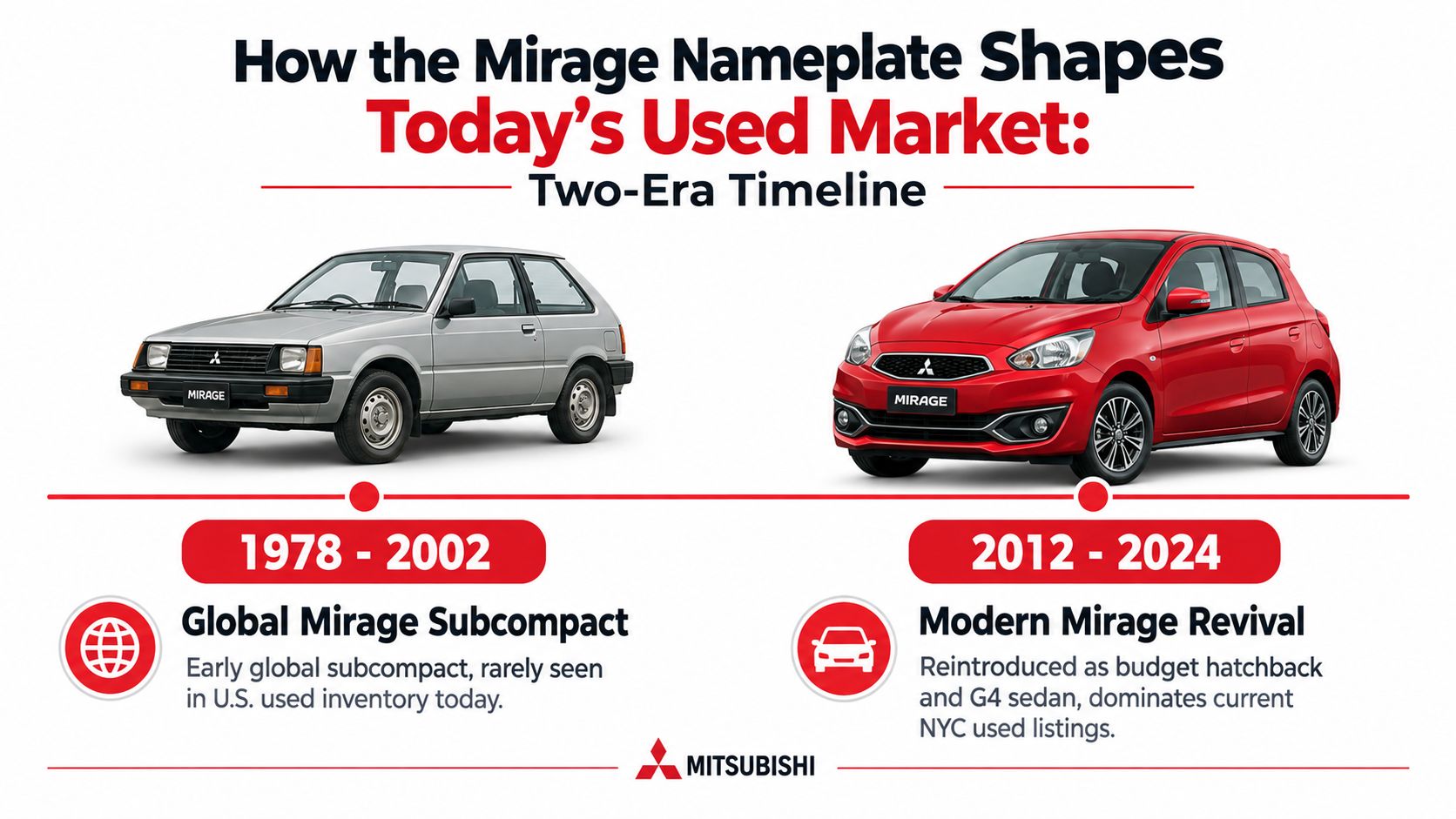
The Mirage has one of the cleaner histories in the subcompact world, but buyers need to separate the old global Mirage from the one they’ll find on a lot in Queens.
Two eras, only one matters for most NYC shoppers
The original Mirage ran from the late 1970s through the early 2000s globally. Those cars are mostly irrelevant to the average used buyer here. If one shows up, it’s usually a hobby car, not daily transportation.
The Mirage you’ll shop is the modern revival. In the United States, sales began with 2,935 units in the part-year 2013 launch, rose to 16,708 in 2014, and reached 26,966 in 2019, according to the U.S. sales history for the Mitsubishi Mirage. That sales footprint matters because it means there’s real used inventory, not just a few oddball examples floating around.
The three used-market buckets I’d separate
Here’s how I’d break down the modern Mirage market when you’re shopping:
- 2014 to 2015 cars
These are the entry-point cars. They’re usually the cheapest. They also tend to be the most basic and the ones I inspect hardest for deferred maintenance. - 2017 to 2021 cars
This is the middle ground. These often strike the best balance between age, equipment, and remaining life. - 2022 to 2024 cars
These are the final-run cars. If you want the newest used Mirage, this is the lane. Expect stronger asking prices and quicker interest from budget-focused buyers.
The used Mirage market isn’t random. It follows the model’s long run, broad sales footprint, and very clear final chapter in the U.S.
That’s why I tell buyers not to shop a Mirage by badge alone. Shop it by era. On this model, that changes the whole deal.
Body Styles and Trims Worth Considering
The first body-style decision is easy. If you live with NYC parking every day, the hatchback is the default answer. If you keep valuables in the car on the street and want a separate trunk, the G4 sedan has a case.
The 2024 Mirage is tiny in the best possible way for city life. It measures 151.4 inches long, rides on a 96.5-inch wheelbase, weighs 2,084 pounds, offers 5-passenger seating, has 6.3 inches of ground clearance, and provides 47.0 cubic feet of cargo capacity, according to Kelley Blue Book’s 2024 Mirage dimensions and specs. That compact footprint is a real advantage when you’re trying to slide into a curbside space in Astoria or Jackson Heights.
Hatchback versus G4 sedan
For most buyers, the choice comes down to how you use the car during the week.
| Body / Trim | Body Style | Key Features | Best For |
|---|---|---|---|
| Mirage ES | Hatchback | Lowest-cost setup, basic commuter spec | Street parkers and first-time buyers |
| Mirage LE | Hatchback | Added convenience and appearance upgrades | Buyers who want a nicer daily driver without overpaying |
| Mirage Carbonite Edition | Hatchback | Cosmetic upgrades, sharper look | Drivers who care about appearance more than feature maxing |
| Mirage SEL | Hatchback | Top trim feel, more comfort-oriented equipment | Buyers who specifically want the nicer trim experience |
| Mirage G4 ES/LE/SEL | Sedan | Separate trunk, traditional shape | People who want cargo privacy on the street |
My trim advice
I wouldn’t chase top trim just because it exists. On a Mirage, value matters more than bragging rights.
- ES makes sense if your goal is simple transportation at the lowest buy-in.
- LE or Carbonite Edition usually lands in the sweet spot for buyers who want a little style or convenience.
- SEL only makes sense if you know you want the extra equipment and find a clean one at a sensible price.
A few realities matter here. There’s no AWD, no hybrid version, and you shouldn’t expect a deep bench of advanced safety tech on every used example. This is a simple economy car. Buy it like one.
If you’re shopping used cars Mitsubishi Mirage in NYC, I’d lean hatchback first, sedan second. The hatch better matches how people here live.
Powertrain, MPG, and Common Mechanical Issues
Every used Mirage asks you to accept the same basic bargain. You give up speed, and you get efficiency plus simplicity.
The engine is a 1.2-liter three-cylinder rated at 78 horsepower and 74 lb-ft of torque. Fuel economy is the payoff. Recent hatchbacks are rated at 36/43 mpg city/highway, and the G4 sedan comes in at 35/41 mpg, according to Kelley Blue Book’s Mirage powertrain and fuel economy details.
What that feels like on NYC roads
Around Queens, Brooklyn, and lower-speed city traffic, the Mirage is fine. It moves cleanly, it’s easy to place, and it doesn’t punish you at the pump.
On the BQE, Cross Bronx, or an aggressive merge onto a fast parkway, you feel the limits fast. The engine has a narrow comfort zone. Push it hard and it sounds busy. Load it with passengers and luggage, and you’ll notice the lack of reserve.
| Model Year Range | Body Style | Transmission | Horsepower | EPA MPG (city/hwy/combined) |
|---|---|---|---|---|
| Recent Mirage hatchback | Hatchback | CVT | 78 hp | 36 / 43 / 39 |
| Recent Mirage G4 | Sedan | CVT | 78 hp | 35 / 41 / not listed |
The 39 mpg combined figure for the 2024 Mirage appears in Car and Driver’s Mirage specifications.
The CVT is the make-or-break issue
Most Mirage complaints I hear from buyers center on the CVT, not because every unit is bad, but because the driving feel isn’t for everyone. Off the line, it can feel sluggish. Under hard throttle, revs can hang. Older or neglected cars may also develop a whiny character that’s hard to ignore once you hear it.
More important than feel is service history. Mitsubishi issued a technical service bulletin for certain Mirage and Mirage G4 CVT models covering shift shock when stopping or re-engaging drive, tied to clutch and torque-converter engagement timing, with the prescribed fix being ECU reprogramming, as stated in the NHTSA-published Mitsubishi CVT service bulletin.
If a used Mirage with a CVT drives oddly in stop-and-go traffic, don’t explain it away. Either the software history is documented or the car needs more scrutiny.
My mechanical take
I like the Mirage’s simplicity. I don’t like neglected examples.
Watch for these practical concerns:
- CVT behavior: hesitation, flare, or shudder in repeated stop-and-go driving
- Throttle response: dirty throttle body symptoms can make a cheap car feel cheaper
- General aging signs: rough idle, weak cold-start behavior, and delayed engagement into drive
For a borough commuter, the trade-off can still work well. For a highway-heavy driver, this powertrain gets old quickly.
Reliability, Recalls, and Long-Term Durability
The Mirage isn’t a miracle car, but it also isn’t the disaster some people assume. It’s better judged as a basic commuter with a finite comfort ceiling, not as a car that needs to excel at everything.
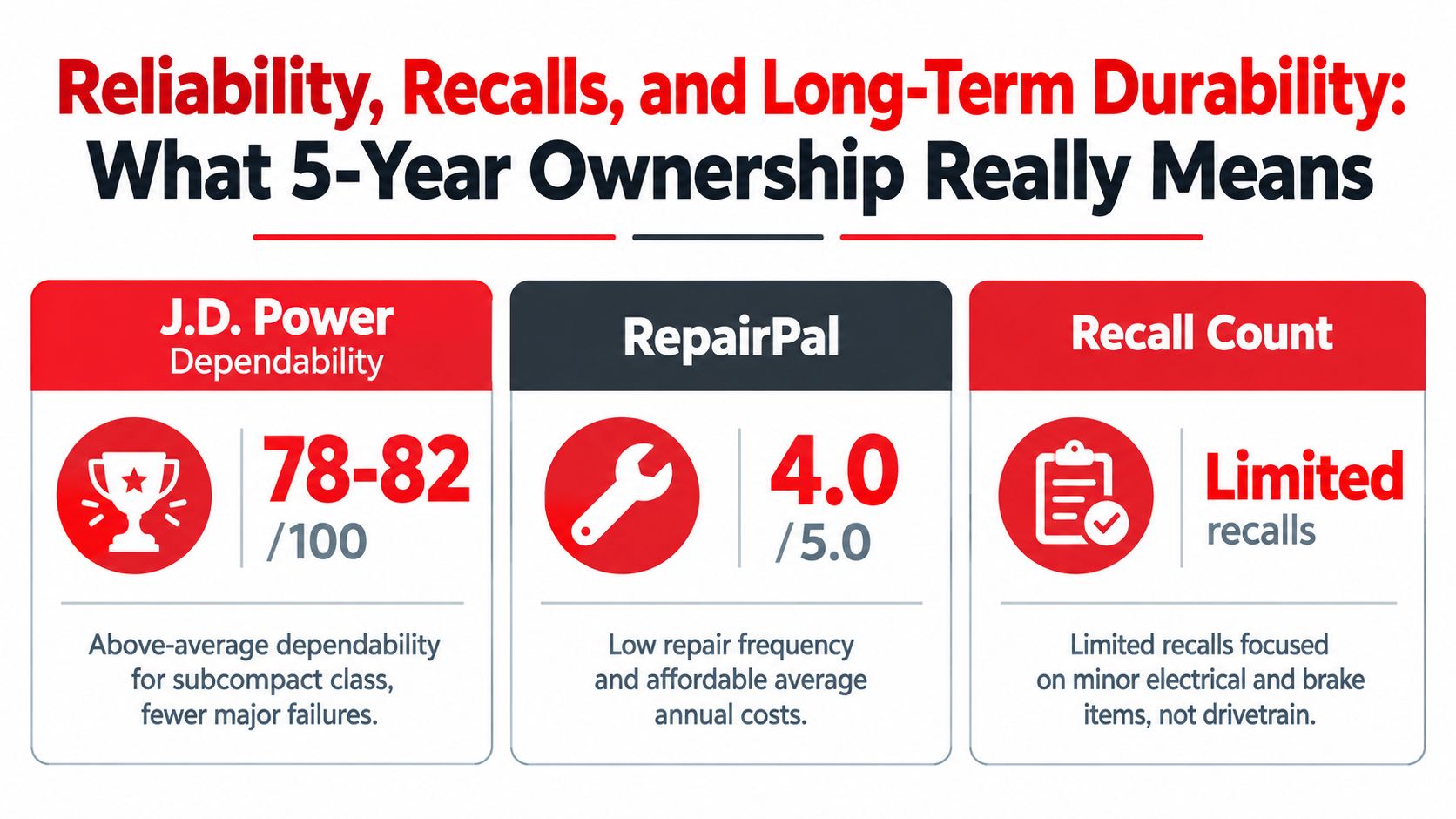
Recent reliability data gives it an average lifespan of about 130,157 miles, a 7.1/10 reliability score, and a 3.1% chance of reaching 200,000 miles, according to iSeeCars reliability data for the Mitsubishi Mirage. My read on that is straightforward. It can serve a buyer well, but you shouldn’t buy one assuming it’s automatically your 200,000-mile hero.
What the recall and complaint picture tells me
A useful NHTSA-based summary reports 95 owner complaints and 6 recall campaigns across 2015 to 2024, with air bags listed as the most reported issue area, while also noting that no model year rises to an overall avoid rating in current federal data, as summarized in this Mirage year-by-year recall overview.
That’s the nuance buyers need. This car has known recall and complaint history, but not a giant red flag that automatically kills the deal. On a used Mirage, I care less about online drama and more about whether recall work was completed and whether the car feels sorted on a road test.
My durability verdict for NYC use
For city duty, a maintained Mirage can make sense. For constant high-speed work, I’d choose something with more power and a calmer highway character.
Here’s how I’d frame it:
- Good fit: city commuting, short to moderate daily drives, tight parking, low-cost ownership mindset
- Borderline fit: mixed city and highway use if you’re realistic about performance
- Poor fit: buyers who routinely drive long, fast stretches with passengers or cargo
A Mirage survives best when the owner respects what it is. Keep it serviced, don’t ignore transmission behavior, and don’t buy it for a mission it was never built to handle.
In NYC, I’d also pay close attention to suspension feel, brake condition, and underbody wear from potholes and winter grime. The city can age a cheap car fast.
Why Discontinuation Changes the Deal in 2026
The Mirage’s exit from the U.S. market changed the used conversation immediately.
Mitsubishi said the Mirage was discontinued in the United States after the 2024 model year, that there would be no 2025 Mirage, and that production would cease in late 2024, with dealer stock expected to last into summer 2025, according to Fortune’s report on the Mirage discontinuation. For a used buyer, that matters because it closes the pipeline. There’s no fresh replacement coming.
What happened right before the end
The final sales pattern is even more revealing. U.S. Mirage sales jumped to 29,768 in 2024, up 125.2% from 13,220 in 2023, before dropping to 14,489 in 2025 and just 43 units in January through June 2026, according to the Mirage U.S. sales timeline. That tells me buyers rushed the remaining new inventory on the way out.
The result in 2026 is simple. People who would’ve bought a new cheap commuter now have to chase used stock instead, especially newer low-mileage examples.
Why that helps and hurts used buyers
It helps if you own a clean later Mirage, because the car isn’t disappearing from the road overnight and there’s still recognition in the market.
It hurts if you’re shopping and expect endless cheap choices. The cleanest later cars won’t sit forever. Budget buyers, first-time buyers, and city commuters all know what this car is meant to do.
I think 2026 is a more rational time to buy than the immediate post-discontinuation scramble. Inventory has had time to sort itself a bit. But I wouldn’t drag my feet if you specifically want a later car with modest mileage and complete records.
My blunt advice
If you want a used Mirage, buy one because it solves a transportation problem cheaply and efficiently. Don’t buy it as a collector story or because you think discontinuation magically makes every example valuable. It doesn’t.
The best deals in 2026 are on honest, clean, properly serviced cars. The worst deals are on rough ones wearing “last of its kind” hype.
Inspection and Financing Tips for NYC Shoppers
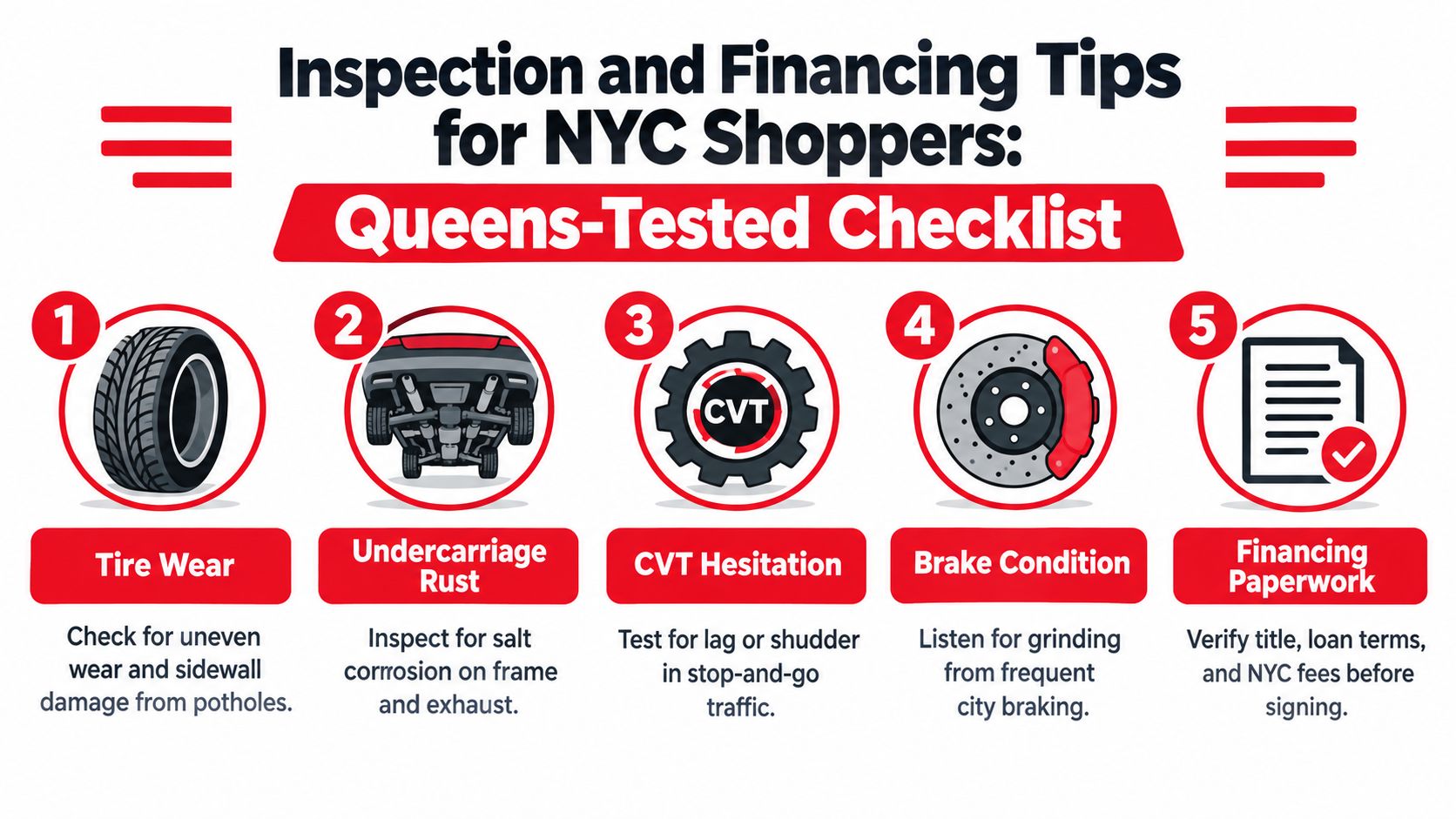
A used Mirage inspection in New York needs to be tougher than a generic checklist. City cars get scraped, bumped, salt-soaked, and left parked for long stretches. A pretty detail job means nothing if the underbody is crusty and the transmission acts strange on Queens Boulevard.
What to check before you even drive it
Start cold. Don’t let the seller warm it up first.
- Tires first: uneven wear can point to alignment issues, curb hits, or suspension wear from potholes.
- Undercarriage next: look for rust, flaky hardware, and exhaust corrosion from winter road salt.
- Interior clues: damp smells, stained carpet, or odd electrical behavior can point to flood exposure.
- Panel condition: on a Mirage, minor city scars are normal. Sloppy body repair isn’t.
If you’re shopping through a dealer, ask for service records, recall status, and any reconditioning paperwork. If you’re comparing local options, Northstar Mitsubishi is one place where buyers can browse used inventory, check financing tools, and review pre-owned availability before showing up in person through the Northstar Mitsubishi website.
What to feel on the road test
Use city traffic, not an empty side street, to judge this car.
A proper Mirage test drive in NYC should include stop-and-go sections, a few rough pavement patches, and at least one faster merge.
Listen and watch for:
- Delayed CVT engagement: put it in drive and note whether it responds cleanly
- Shudder or shift shock: especially when slowing to a stop and moving again
- Brake noise: city cars chew through brakes
- Warning lights: don’t rationalize transmission or engine lights away
Ask the salesperson one direct question: “Has this car had CVT software updates or transmission-related service, and can you show me the paperwork?”
Financing without getting sloppy
The Mirage attracts budget-minded shoppers, which means the financing details matter as much as the car.
New York used-vehicle tax can sting. In NYC, the sales tax on used vehicles over $500 is 8.875%. Build that into your out-the-door math before you talk yourself into a payment.
A few financing rules I like:
- Get pre-approved first. A credit union or outside lender gives you a benchmark.
- Negotiate the total deal, not just the monthly payment.
- Read the doc fee and add-ons carefully. Borough to borough, those numbers can get silly.
- Match the term to the car. Don’t stretch a basic used Mirage into a loan that outlives the car’s sweet spot.
This car only works as a value play if you buy it like a disciplined adult. Overfinance it, skip the inspection, and the bargain disappears.
Is a Used Mitsubishi Mirage the Right Fit for You
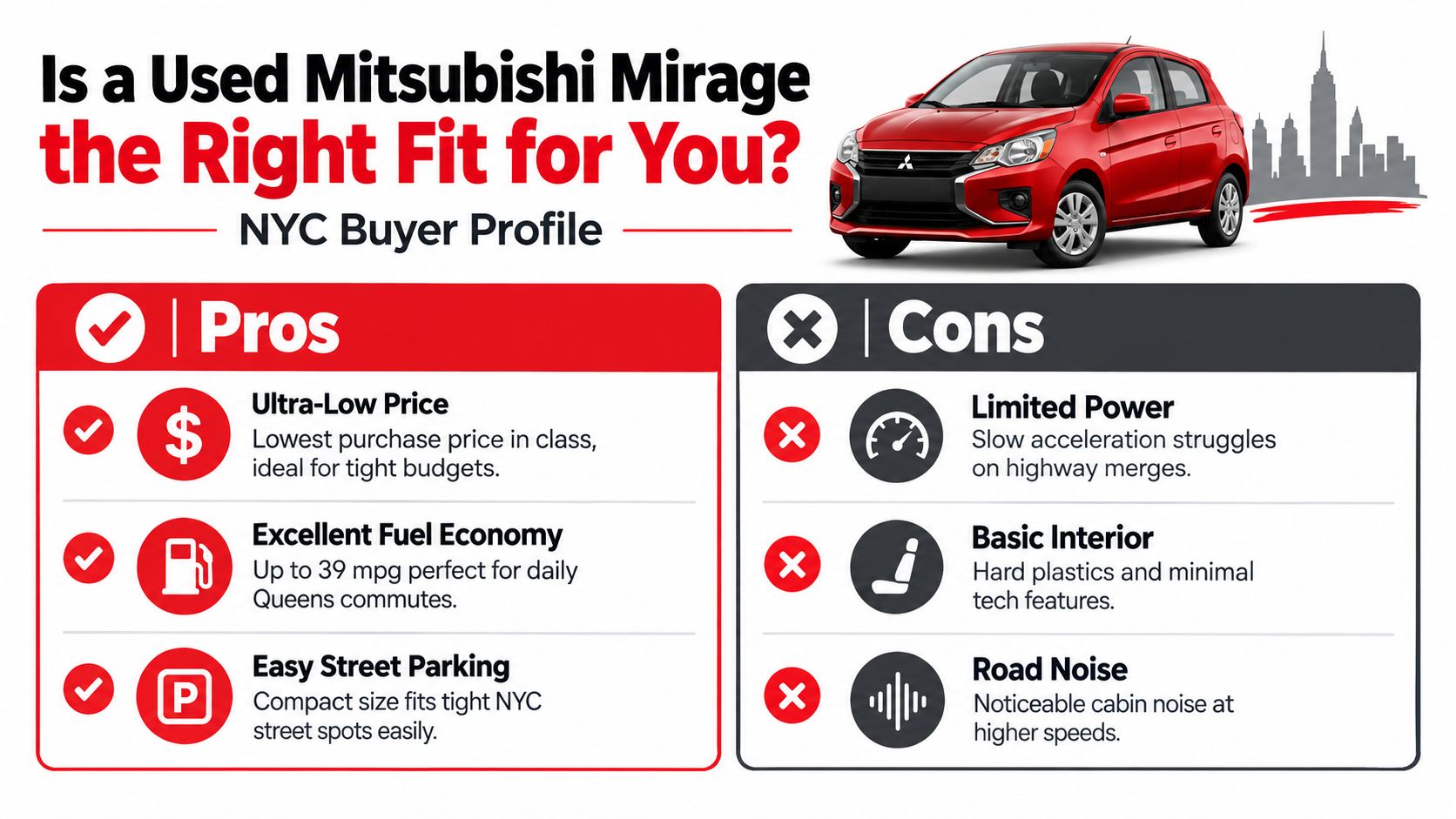
By 2026, the Mirage is one of those cars that makes perfect sense for the right person and almost no sense for the wrong one.
The buyer who usually does well
I like the Mirage for the buyer who answers yes to most of these:
- You park on the street and care about easy maneuvering more than presence.
- You drive modest daily mileage and spend more time in borough traffic than flying down open highways.
- You want low running costs and don’t need a lot of power.
- You can live with basics if the car is dependable and efficient.
That can be a student commuting from the Bronx, a budget-minded worker crossing Queens all week, or a household that just needs a second car that won’t be precious.
The buyer who should pass
Some people need to hear the no.
Skip the Mirage if you regularly do long, fast highway runs, if you carry adults in the back often, or if you know road noise and slow acceleration will annoy you every single day. Also skip it if you’re shopping emotionally. This is not a car you buy to fall in love with. It’s a car you buy to solve a problem cheaply.
My final buying filter
Before signing, answer these three questions clearly:
- Which model year range am I buying, and why that range?
- Is the mileage reasonable for a city car with documented service?
- At this price, am I still getting a value car, or am I paying too much for the Mirage name alone?
If your answers are solid, a used Mitsubishi Mirage can still be one of the more practical commuter buys in New York. If those answers feel fuzzy, keep shopping.
If you’re comparing used Mirage options in NYC, Northstar Mitsubishi can help you check current pre-owned and certified inventory, review financing tools, and line up service support in Long Island City. Browse what’s available and plan your next step at Northstar Mitsubishi.
0 comment(s) so far on Used Cars Mitsubishi Mirage: Smart Buying Guide for 2026