
Outlander Used Car for Sale: A Smart Buyer’s Guide
You’re looking at a used SUV listing during a short lunch break, trying to decide whether the Outlander in Queens is a smart buy or just a cheap vehicle with an expensive problem waiting underneath. You need room for family, groceries, and weekend trips, but you also need something manageable on Brooklyn streets and realistic to park in the city.
That’s where a used Mitsubishi Outlander makes sense. It offers practical SUV space without forcing you into a new-car payment, and its long history gives shoppers a wide range of generations, prices, and equipment to compare. This guide will help you decide which generation to target, how depreciation affects your budget, what to inspect, whether certified pre-owned coverage is worth paying for, and how to complete a local purchase without wasting half a day.
Table of Contents
- Why a Used Outlander Makes Sense in the City
- Understanding the Outlander Generations
- Which Model Years Deserve Your Attention
- What Depreciation Means for Your Budget
- Your Pre-Purchase Inspection Checklist
- Is Certified Pre-Owned Worth It
- Buying Your Used Outlander in the NYC Area
Why a Used Outlander Makes Sense in the City
A buyer shopping between Queens and Brooklyn often has two problems at once: the new three-row SUV fits the family, but its payment does not fit the budget. A three-year-old Outlander can solve that gap. It provides useful passenger flexibility while the first owner has already absorbed much of the steepest new-car depreciation.
That is the practical case for an Outlander used car for sale. You can find more than a basic commuter. Depending on the year and trim, an Outlander may offer three-row seating, driver-assistance equipment, and enough cargo room for groceries, school runs, and trips beyond the five boroughs. In a dense market like NYC, its long production run means listings in every price band appear regularly. The model’s history is documented in Mitsubishi’s official model history.
The city buyer’s five decisions
A smart purchase depends on five checks:
- Generation: Choose the lower price of an older Outlander only when its condition and records justify the savings. Newer generations bring updated styling and equipment.
- Model year: Check the recall history for that specific year, then confirm that required repairs were completed. Compare drivetrain, seating, service records, and condition, not just the advertised price.
- Depreciation: Let the vehicle’s value decline work in your favor, but reject any discount that comes with missing records or unresolved recalls.
- Inspection: Have the exact SUV examined and driven. A clean listing cannot prove that its CVT, electronics, brakes, or battery are healthy. For a battery-equipped version, request condition evidence rather than accepting a seller’s verbal assurance.
- Purchase process: Complete inventory research, trade valuation, financing pre-qualification, and recall checks before visiting whenever possible. That keeps a short NYC dealership visit focused.
The Outlander works well as a single household vehicle. It handles school runs and tight urban streets, then carries passengers and luggage for a weekend outside the city. Its compact footprint will not remove parking stress, but it is easier to place and live with than a much larger SUV.
Model-year-specific documentation matters more than a low odometer reading. Ask for the vehicle history, maintenance invoices, open-recall status, and battery-related evidence where applicable before signing anything.
Practical rule: Buy the individual vehicle, not the advertised model year. A well-documented older Outlander is a better purchase than a newer one with unresolved recalls, poor maintenance records, or signs of accident repair.
The right listing earns a test drive by proving its condition, not by carrying the lowest price.
Understanding the Outlander Generations
“Used Outlander” describes several very different vehicles: the compact first generation, the larger second generation, the third generation sold through the mid-2010s and beyond, and the redesigned model introduced for 2022. Treating them as one SUV leads to poor comparisons. Body size, cabin design, seating availability, powertrains, technology, and likely purchase price change significantly from one generation to the next.
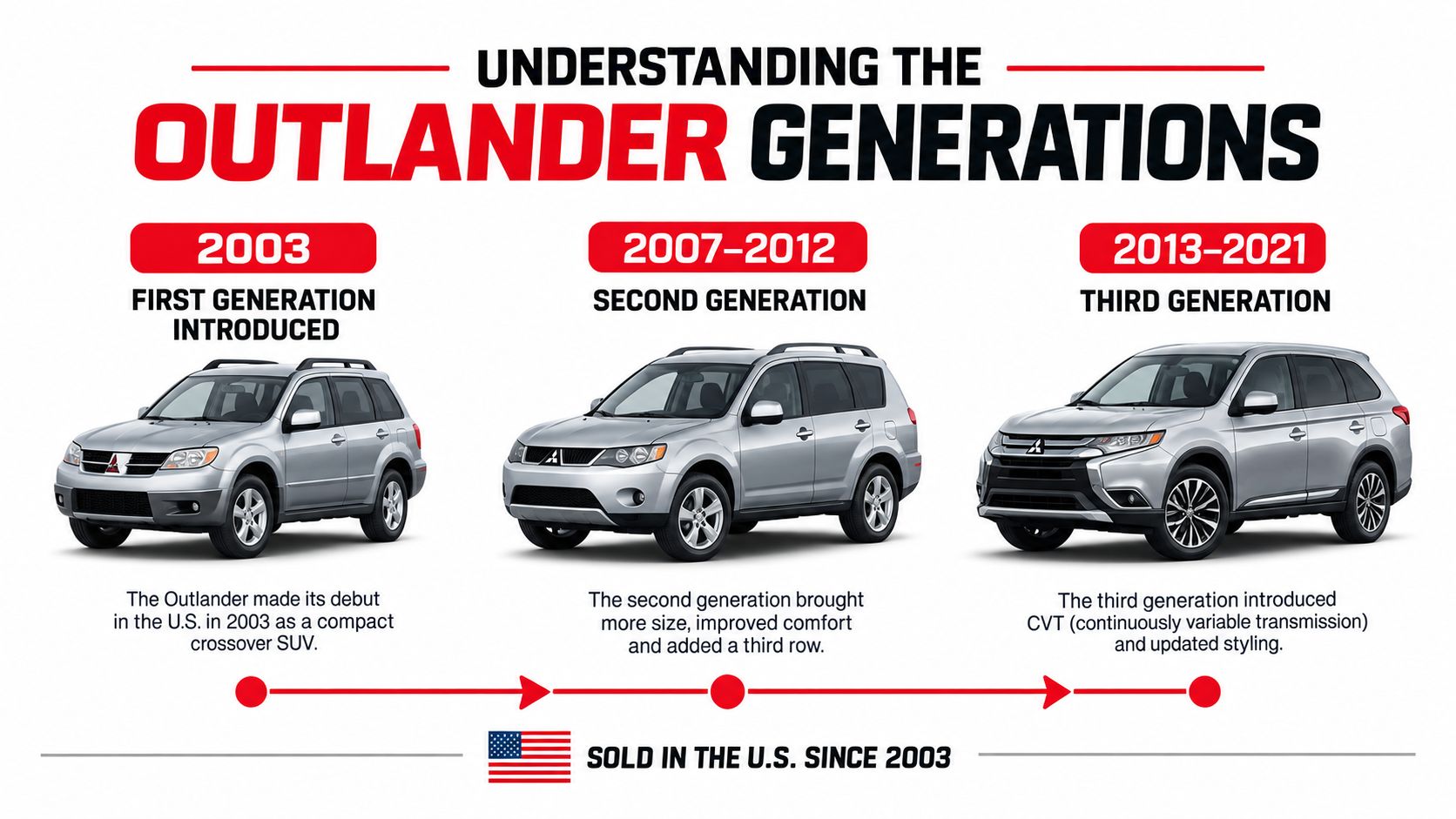
A used Outlander works like a used laptop comparison. Age affects not only appearance, but also the battery design, electronic systems, available software, and remaining support. For an NYC buyer with limited time, the generation narrows the inspection questions before you spend an afternoon visiting dealerships.
First and second generation options
The earliest U.S. Outlanders are usually the lower-cost option. Their older styling, simpler interiors, and age can suit a buyer who needs basic transportation without current-generation pricing. Expect fewer modern driver-assistance features and inspect the vehicle more aggressively. Corrosion exposure, accident repairs, previous ownership, suspension wear, and maintenance records matter more than the Mitsubishi badge.
The second generation brought a larger, more family-focused body and more useful passenger flexibility. It can make sense for a buyer who wants an older three-row-capable layout without paying for a newer redesign. Seating and equipment vary by vehicle, so verify the actual configuration through the VIN, window sticker, or vehicle history records. Do not assume two similar-looking listings have the same number of seats or powertrain.
Third generation and the modern break
The third-generation Outlander covers the long period before the redesign and is often the easiest generation to find in the used market. Its restrained styling can help keep purchase costs below newer examples, while its practical cabin suits commuting, errands, and occasional passengers. Some vehicles are plug-in hybrids, so identify the powertrain from the records and inspect the high-voltage battery, charging equipment, and related service evidence. A seller’s verbal assurance is not enough.
The 2022 redesign creates the clearest dividing line. It brought a more substantial exterior, a different cabin presentation, and a more contemporary driving environment. The 2025 gasoline model uses a 2.5-liter MIVEC DOHC inline-4, produces 181 horsepower and 181 lb-ft of torque, uses a CVT, and seats up to 7 passengers, according to Car and Driver’s 2025 specifications.
For a strict budget, start with a documented third-generation vehicle. For family use, confirm the post-redesign seating layout. For an electrified commute, prioritize battery-condition evidence and charging-system checks over a low asking price.
Which Model Years Deserve Your Attention
You have one afternoon to shop in New York City, and two Outlander listings look nearly identical. Start with a documented 2023, 2024, or 2025 Outlander. Consider a 2022 Outlander only when its price clearly reflects the added recall scrutiny and the seller provides complete service records.
Early 2022 Outlanders had reported recalls involving the fuel pump, roof pillar weld, rearview camera, and child restraint belts, according to iSeeCars’ Outlander reliability and recall information. Those campaigns do not automatically rule out a 2022. They do require proof that repairs were completed on the exact vehicle you plan to buy. Ask for the VIN before spending time on a test drive.
Recent model years have a narrower reported recall profile. CarGurus’ Outlander buying guidance identifies one recall each for the 2024 and 2025 models. That makes these newer post-redesign years easier to recommend when condition, equipment, and price are comparable. For a plug-in-hybrid listing, also demand battery-health results, charging-system records, and related service documentation. A clean body and a low asking price do not establish battery condition.
Used Outlander Model Year Snapshot
| Model Year | Recall Exposure | Powertrain | Fuel Economy FWD | Seating |
|---|---|---|---|---|
| 2022 | Fuel pump, roof pillar weld, rearview camera, and child restraint belt recalls reported | 2.5-liter inline-4, CVT | 24/31 mpg city/highway | Confirm exact configuration |
| 2023 | No open recalls widely reported; VIN check still required | 2.5-liter inline-4, CVT | 24/31 mpg city/highway | Confirm exact configuration |
| 2024 | One recall reported; completion should be confirmed by VIN | 2.5-liter inline-4, CVT | 24/31 mpg city/highway | Confirm exact configuration |
| 2025 | One recall reported; completion should be confirmed by VIN | 2.5-liter inline-4, CVT | 24/31 mpg city/highway | Up to 7 passengers |
Across the 2024 gasoline configuration, the powertrain produces 181 hp and 181 lb-ft of torque. Kelley Blue Book’s 2024 Outlander specifications reports EPA fuel economy of 24/31 mpg city/highway for front-wheel drive and 24/30 mpg for AWD, with combined ratings of 27 mpg and 26 mpg, respectively. AWD reduces fuel economy slightly without increasing engine output.
Before visiting any listing, request the VIN and compare its recall status with the seller’s repair orders and service history. If the seller will not provide enough information to verify the vehicle, remove it from your shortlist.
What Depreciation Means for Your Budget
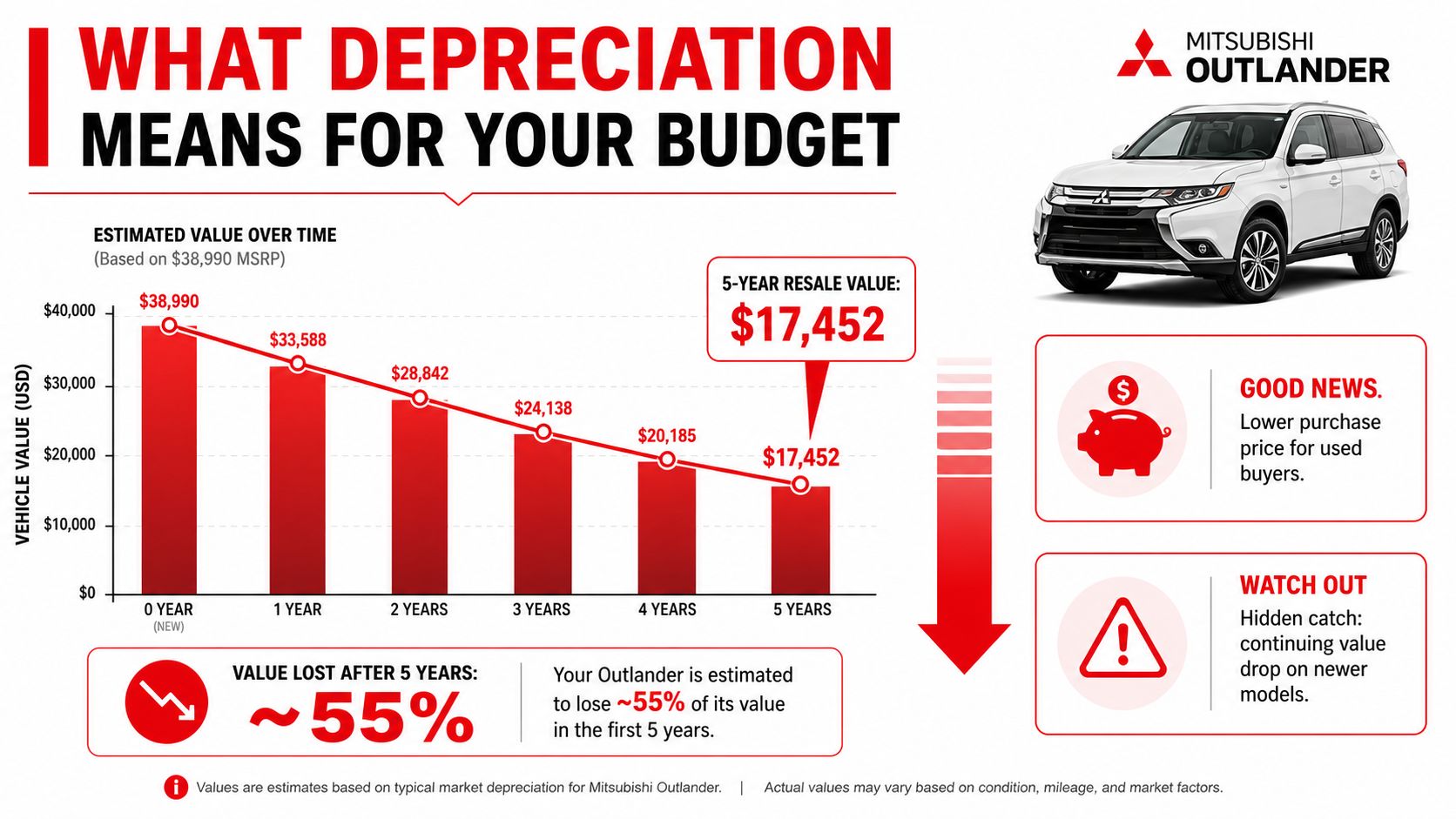
Depreciation gives used-Outlander buyers negotiating room, but it also sets the limit for what a low asking price can realistically mean. CarEdge estimates that an Outlander loses about 55% of its value after five years, leaving a projected five-year resale value of $17,452 under assumptions of good condition and 13,500 miles per year, as shown in CarEdge’s Outlander depreciation analysis.
Edmunds offers a second reference point. For a 2025 Outlander in good condition, it estimates $16,275 in total depreciation over five years, according to Edmunds’ 2025 Outlander appraisal information. CarGurus’ buying guide reports that the model has typically lost about 33% of its original value over three years.
Use those figures to set a buying range, not to accept every cheap listing. A one-to-three-year-old Outlander usually offers the strongest balance between current equipment and a price that reflects the first owner’s largest depreciation hit. For an NYC buyer with limited time, a 2023 example deserves close attention because it combines the post-redesign cabin and features with a lower entry price than a new vehicle.
The low-price trap
A low price can hide ownership costs. Depreciation leaves less room for mistakes when neglected maintenance, unresolved recall work, or uncertain battery condition erases the initial savings. Require a clean title, consistent service records, completed recalls, and documented evidence that the vehicle’s battery system is in acceptable condition before you treat the discount as a deal.
Compare similar listings in this order:
- Condition first: Reject vehicles showing structural damage, inconsistent panel gaps, severe tire wear, or warning lights.
- Records second: Favor documented maintenance over a seller’s claim that the SUV was “regularly serviced.”
- Recall status third: Confirm repairs using the exact VIN, especially on early redesigned examples.
- Price fourth: Negotiate from verified condition, not the cheapest online advertisement.
At roughly 33% depreciation by year three, a 2023 example absorbs the steepest loss while keeping the post-redesign warranty window mostly intact. Budget for the vehicle’s actual condition, not just its sale price.
Your Pre-Purchase Inspection Checklist
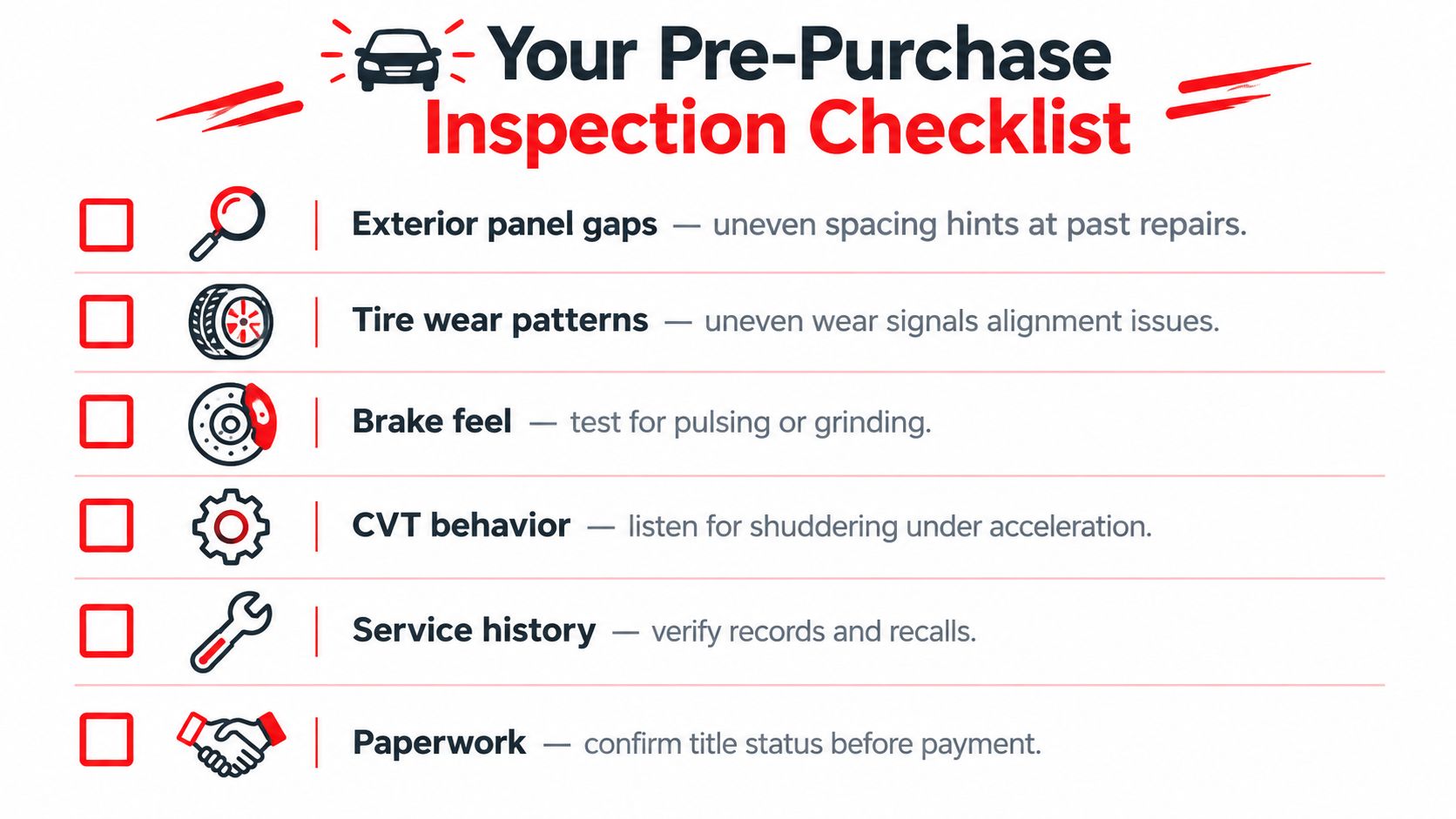
A test drive should do more than confirm that the Outlander moves. It should help you identify evidence of accident repairs, neglected maintenance, electrical faults, and drivetrain problems before you hand over money.
Start with the body and tires
Walk around the SUV in daylight. Compare the spacing between body panels, inspect paint for mismatched shades, and look for overspray around trim or door seals. Uneven panel gaps don’t prove a major accident, but they justify a closer inspection and a vehicle-history review.
Check every tire for uneven wear. Wear on one shoulder can suggest alignment or suspension trouble, while mismatched tires may indicate that the previous owner replaced them without addressing the underlying issue. Look underneath for fluid leaks, damaged plastic shields, or fresh undercoating that could conceal repairs.
Evaluate the controls on the road
The brake pedal should feel consistent, without grinding, excessive vibration, or a pulsing sensation. During acceleration, pay attention to the CVT. A smooth rise in engine speed is normal, but shuddering, hesitation, or unusual whining deserves a professional diagnosis before purchase.
Test the equipment you’ll use in city driving:
- Electronics: Operate the infotainment screen, cameras, climate controls, windows, locks, and USB connections.
- Driver assistance: Test available blind-spot monitoring, lane-warning functions, parking sensors, and adaptive cruise controls.
- Cabin climate: Run both heating and air conditioning, including the fan at different settings.
- Documentation: Match the VIN on the vehicle with the title, listing, service records, and recall paperwork.
The seller should allow an independent inspection. If they refuse, the vehicle has failed an important part of the buying process before you’ve even negotiated.
PHEV battery and charging checks
Treat a used Outlander PHEV as an electric system plus a gasoline vehicle. The dashboard’s displayed range is only one clue. Independent used-car guidance from SAKA recommends verifying charging on both a standard charging point and the included cable, requesting a battery health report when available, and testing heating and air conditioning.
The 2025 Outlander PHEV has an EPA-estimated 38 miles of electric-only range from a 20-kWh battery pack, and it’s rated at 26 mpg combined when operating as a plug-in hybrid, according to Mitsubishi’s technical specifications. Those specifications explain why battery evidence matters to the price. A promising range display doesn’t confirm charging reliability, battery condition, or thermal-system performance.
Ask for charging proof, inspect the charge port, and require an explanation for any warning message. A PHEV that cannot demonstrate normal charging isn’t a bargain until the repair cost is known.
Use the following video as an additional visual reference before your appointment:
Is Certified Pre-Owned Worth It
For an NYC buyer with limited time, Mitsubishi Certified Pre-Owned coverage earns its premium when the SUV fits your budget and you plan to keep it for years. The program includes a reinstated 10-year/100,000-mile powertrain warranty that starts on the vehicle’s original in-service date or first use, whichever comes first, according to Mitsubishi Motors North America’s certified pre-owned program.
Ask for the certification paperwork before you visit. It should show the inspection results for the engine, transmission, brakes, tires, lights, safety equipment, and other covered systems. That written record matters in New York City, where a buyer may not have time for repeated dealership visits or a second round of troubleshooting after purchase.
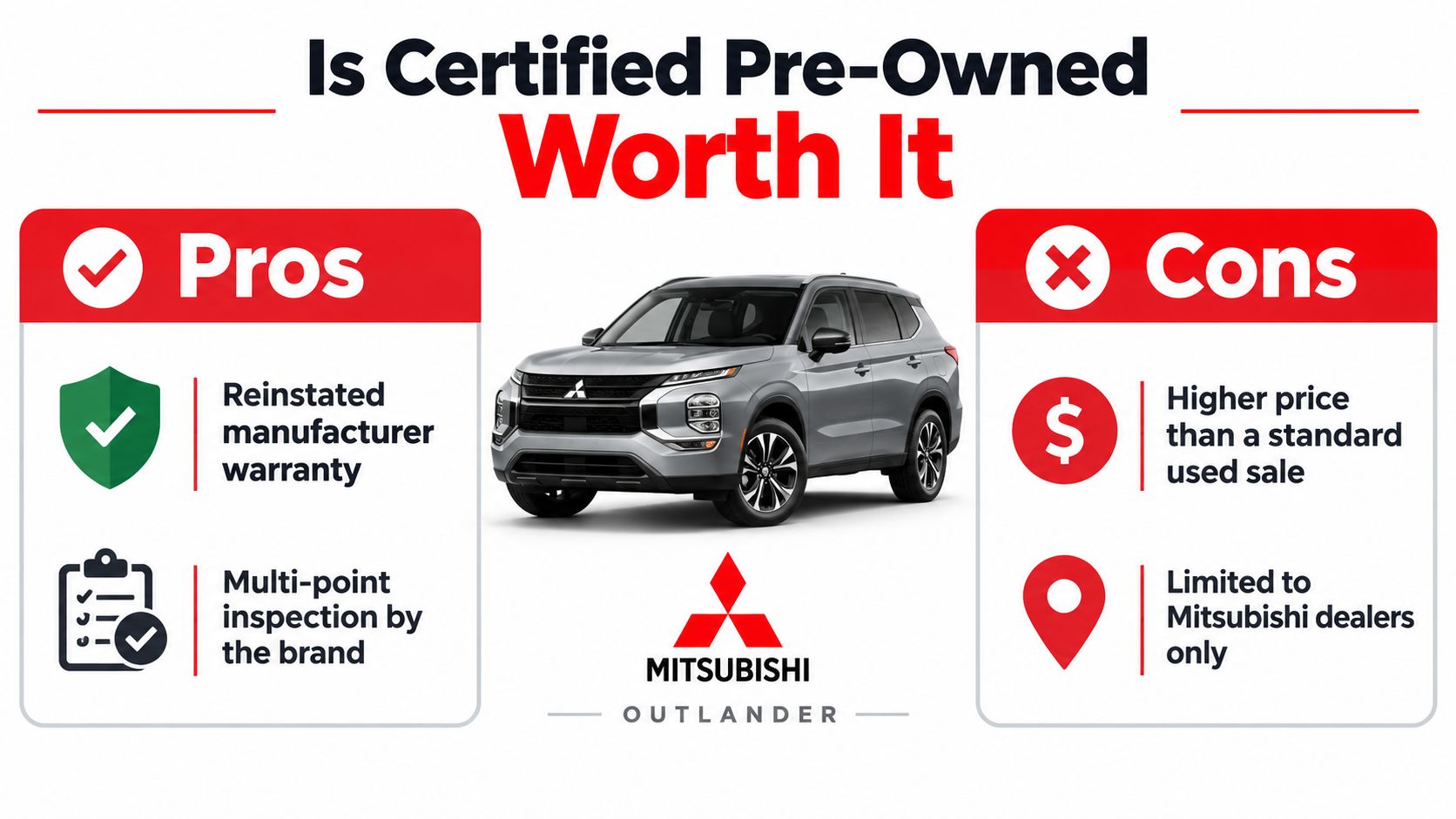
The warranty reduces exposure to major covered powertrain repairs. It does not make a neglected Outlander a sound purchase. Confirm the remaining coverage for the exact VIN, because the warranty clock starts with the vehicle’s original in-service date, not the day you buy it.
Who should choose CPO
Certified coverage makes the strongest case for:
- Long-term owners: Warranty protection matters more if you expect to keep the SUV well beyond the purchase period.
- Risk-conscious buyers: Ask for model-year-specific recall records, especially when reviewing an early 2022 Outlander with reported recall exposure. Certification does not replace that VIN check.
- Time-pressed shoppers: A documented inspection can reduce research time, but review every page before signing.
- PHEV buyers: Require battery-condition evidence and charging records. CPO status does not prove battery health or charging performance.
A non-certified Outlander suits a budget-focused buyer who has repair cash available, understands the vehicle’s history, and will arrange an independent inspection. The lower purchase price can be worthwhile, but you assume more responsibility for confirming condition and future repair risk.
| CPO advantage | CPO limitation |
|---|---|
| Reinstated manufacturer powertrain warranty | Usually costs more than a standard used vehicle |
| Written inspection and documentation | Coverage begins from the original in-service date |
| Easier long-term ownership planning | Does not replace a VIN recall or battery-condition review |
CPO should support your inspection, not replace it. Check the title, body, tires, brakes, electronics, CVT behavior, recall status, and certification documents before signing.
Buying Your Used Outlander in the NYC Area
The most efficient purchase starts online. At Northstar Mitsubishi in Long Island City, you can browse pre-owned inventory with budget filters, including options priced under $20,000, then narrow the search by model, drivetrain, mileage, and equipment. If the exact trim isn’t listed, use the Vehicle Finder Service rather than settling for the wrong configuration.
Complete the time-consuming work first
Send the VIN request before visiting. Ask for the vehicle history, recall status, service records, and confirmation that the advertised equipment matches the actual SUV. If you have a current vehicle, request a trade-in valuation or a Kelley Blue Book Instant Cash Offer so you understand your equity position before negotiating.
You can also complete Capital One pre-qualification or a secure online finance application ahead of time. Pre-qualification doesn’t replace final lender approval, but it gives you a clearer budget and reduces the time spent discussing financing in the showroom. That matters when you’re leaving work in Queens, coordinating a trip from Brooklyn or the Bronx, or trying to avoid a second visit.
Make the first visit count
Arrive with a short checklist:
- Inspect the vehicle: Confirm the VIN, title status, body condition, tires, brakes, electronics, and service records.
- Drive it in real conditions: Include city streets, stop-and-go traffic, turns, braking, and a stronger acceleration run to evaluate CVT behavior.
- Verify recalls: Match the VIN results with repair documentation.
- Review the numbers: Separate vehicle price, taxes, registration, financing, trade value, and optional products.
- Plan service: Ask about factory-trained technicians, genuine OEM parts, and the recommended maintenance schedule.
Extended sales and service hours can help urban buyers schedule around work and traffic. After purchase, consistent maintenance through a Mitsubishi service operation and genuine OEM parts can help protect the condition you paid for.
The right Outlander turns the original city dilemma into a manageable decision. You get the flexibility for Queens errands and weekend travel, while a careful inspection and VIN check keep a tempting low price from becoming an avoidable repair bill.
Northstar Mitsubishi offers used and certified pre-owned Outlander options, online inventory tools, trade valuations, financing pre-qualification, and service support for NYC-area buyers. Visit Northstar Mitsubishi to review current inventory, request a Vehicle Finder search, and schedule a focused test drive.
0 comment(s) so far on Outlander Used Car for Sale: A Smart Buyer’s Guide