
Mitsubishi Outlander Sport Buying Guide for NYC
You’re standing on the curb in Queens, checking a listing on your phone between subway stops, and the same thought keeps coming back. You need something small enough to live with in the city, tall enough to handle potholes and snow, and cheap enough that the payment won’t wreck the rest of your month. That’s where a Mitsubishi Outlander Sport keeps showing up on the short list.
It makes sense why. The nameplate has been around for a long time, the used inventory is full of examples from different years, and the question isn’t “Should I buy one?” so much as “Which one should I buy, and what should I check before I hand over the money?” In New York, that question matters even more, because parking, traffic, and daily stop-and-go use can turn a decent purchase into a frustrating one if you skip the details.
This guide walks through the model the way a patient advisor would with a friend who has one free afternoon and a lot of listings to sort through. You’ll learn why the Outlander Sport is still everywhere, how the engines feel in city traffic, which years deserve extra caution, and what to inspect on a test drive before you commit. The goal is simple, help you shop by condition, year-specific risk, and total ownership cost, not by hype around redesigns that barely changed the basics.
Table of Contents
- Introduction to Buying a Used Outlander Sport in NYC
- Why the Outlander Sport Stays Common on the Used Market
- Understanding Trims Engines and Feature Differences
- Reliability by Year and How Long It Can Last
- NYC Inspection Checklist Before You Buy
- Typical Pricing and True Cost of Ownership in the City
- Financing Trade In and Closing Your Purchase at Northstar Mitsubishi
Introduction to Buying a Used Outlander Sport in NYC
A lot of NYC shoppers land on the Outlander Sport after a very familiar search pattern. They start with tight street parking, a commute that mixes lights, bridges, and crowded avenues, and a budget that leaves no room for a sloppy purchase. A compact SUV seems like the sweet spot, but not every compact SUV fits the city the same way, and not every used example is worth the same money.
That’s why this model attracts attention from practical buyers. It’s compact enough to live in the boroughs, but it still gives you a higher seating position than a sedan, which helps when you’re squeezing into traffic or trying to see around a delivery truck. The used market also makes it easy to compare examples side by side, because the model stayed close to the same formula for a long time, so condition and maintenance often matter more than dramatic generation changes.
Practical rule: In a city like New York, the right used SUV is less about the badge and more about how well it has aged in traffic, winters, curb bumps, and short-trip use.
The rest of this guide builds from the ground up. First, you’ll see why the Outlander Sport stays so common on the used market. Then the engine and trim differences get broken down in plain language. After that, the year-to-year reliability picture, the NYC inspection checklist, and the cost question come into focus. If you’ve been comparing listings and feeling like every ad says the same thing, this should help you separate the good candidates from the ones that only look cheap at first glance.
Why the Outlander Sport Stays Common on the Used Market
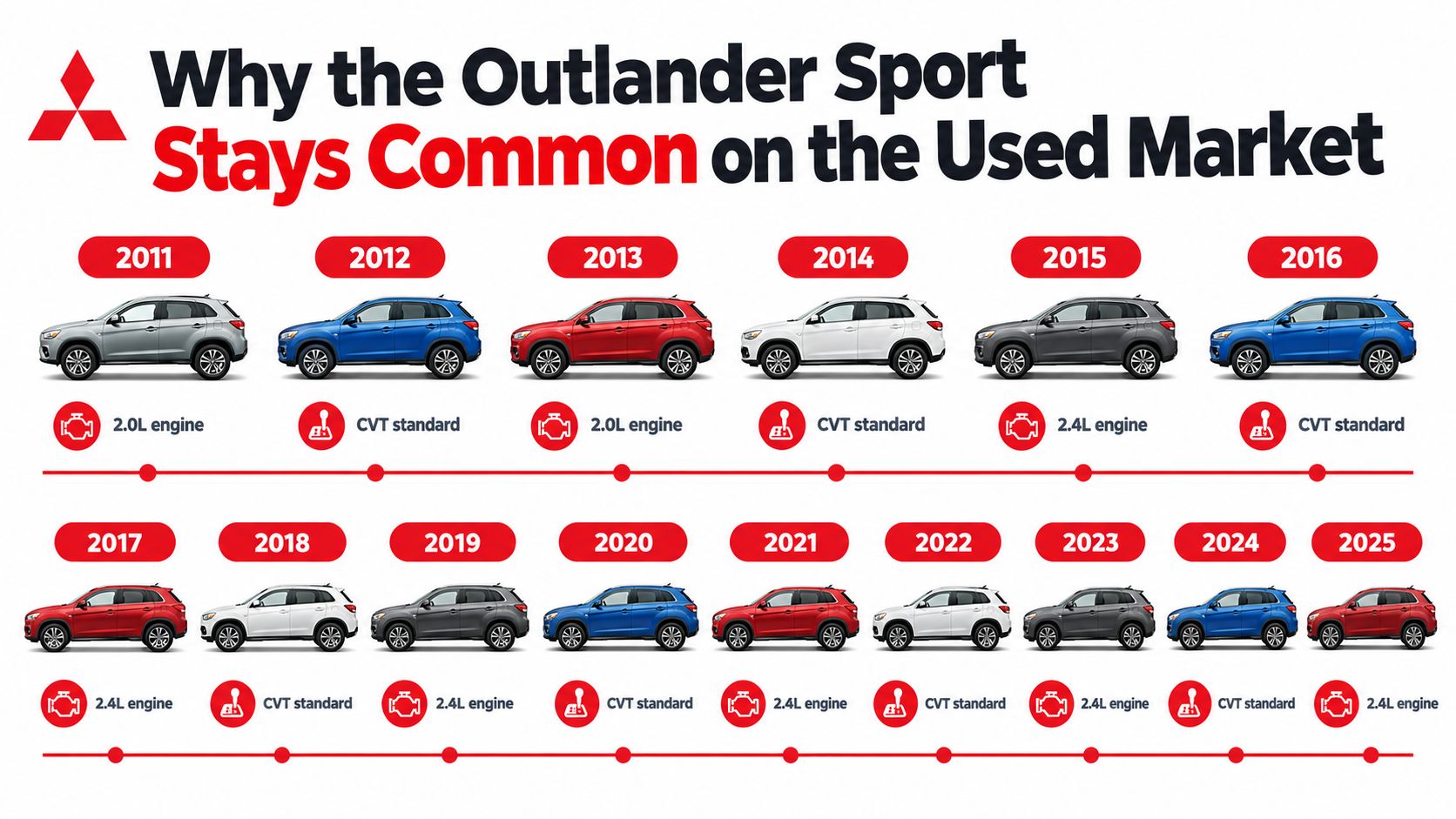
The Mitsubishi Outlander Sport first appeared in the 2011 model year, then stayed in the same general shape for a long stretch. For used shoppers, that matters because a long-running model behaves less like a brand-new redesign every few years and more like the same apartment unit with different furnishings and wear. The basic layout stays familiar, so the key question becomes how each individual vehicle was treated.
That kind of continuity keeps the model easy to shop. In a city like New York, you are usually comparing mileage, maintenance, and condition, not chasing the promise that a newer body style solved every issue. A car that has spent years in short trips, stop-and-go traffic, winter starts, and curbside parking can age in ways the odometer does not fully show. A clean service record tells you more than a fresh wash and a polished listing photo.
The model also stayed visible to safety-minded buyers. IIHS recorded that the 2015 Outlander Sport earned Top Safety Pick, and it was the fourth straight year the model received that designation. IIHS vehicle ratings for the 2015 Outlander Sport That does not make every used example a safe bet, but it helps explain why the nameplate remained familiar to shoppers who want a small SUV with a known footprint and a familiar ownership story.
Why that continuity changes your search
A long production run changes the way the used market reads. On a model that stayed close to the same formula for years, the big shopping questions shift toward condition, mileage, service records, tire wear, brake wear, and transmission behavior. You are not paying for a headline redesign. You are checking how well a specific car survived years of ownership, leasing, and city use.
That is why listings can start to blur together. Once a compact SUV sticks around long enough, a casual buyer sees a row of similar ads and assumes the cars are nearly interchangeable. They are not. One may have lived an easier suburban life, while another may have spent its days absorbing potholes, salt, and repeated cold starts. The difference is like choosing between two apartments on the same block, one cared for, one merely occupied.
The safer approach is simple, buy the history, not the badge.
Understanding Trims Engines and Feature Differences
The biggest day-to-day difference in a used Outlander Sport usually comes down to the engine. The 2.0-liter makes 148 hp and 145 lb-ft, while the 2.4-liter raises output to 168 hp and 167 lb-ft. MotorTrend on the 2022 Outlander Sport powertrains Both are paired with a CVT, so the engine choice affects how the car feels under load more than the drivetrain story alone.
The 2.0-liter is the apartment with the smaller elevator; it works, but you feel it more when the car is full or when you’re trying to merge onto a fast-moving avenue. The 2.4-liter is the same building with a more comfortable lift, so passing and hill climbs take less effort from the engine. In city terms, that extra torque can matter when you’re climbing a ramp into a bridge approach or accelerating from a dead stop into a tight gap in traffic.
Engine choice at a glance
| Feature | 2.0L Engine | 2.4L Engine |
|---|---|---|
| Horsepower | 148 hp | 168 hp |
| Torque | 145 lb-ft | 167 lb-ft |
| Transmission | CVT | CVT |
| Driving feel | More relaxed baseline, easier to find in used listings | Stronger pull for merges and grades |
| Best fit | Buyers focused on the more common used configuration | Buyers who want a bit more reserve under load |
The trim story matters too, but usually in a practical way. On listings, some packages add comfort, tech, or convenience features that are worth paying for if you spend a lot of time in the car, while others are mostly appearance changes. For NYC buyers, the value question is whether the extra equipment makes daily life easier, not whether the badge sounds fancier at the curb.
Good rule for used compact SUVs: spend on the features you’ll touch every day, like seating comfort, audio, visibility aids, and climate controls. Skip the rest if they don’t change your commute.
The safest way to read a listing is to identify the engine first, then the trim, then the equipment. That order matters because an attractive photo won’t tell you whether the car has the more relaxed 2.0-liter setup or the stronger 2.4-liter version, and that difference affects how the SUV feels when it’s loaded with passengers, groceries, or weekend gear.
Reliability by Year and How Long It Can Last
Used Outlander Sport reliability works best as a year-by-year check. That matters in New York, where a clean-looking SUV can still hide a rough past, and where a small problem becomes a bigger annoyance once you’re stuck in traffic or climbing a bridge ramp. Independent used-car data estimates an average lifespan of 148,887 miles, or about 11.4 years, with about 11,155 miles driven per year during the first 10 years of use. The same dataset says the model has an 11.8% chance of reaching at least 200,000 miles. That gives shoppers a reasonable durability benchmark when comparing moderate-mileage examples.
What the year pattern tells buyers
A separate analysis of 870 NHTSA complaints points to 2015 and 2016 as the clearest years to avoid because complaint severity was up to 4.2× the model median, while 2018 and 2021 had the cleanest federal complaint records among older, sufficiently aged years. CarWhere years-to-avoid analysis That does not make every 2015 or 2016 a bad buy, and it does not make every 2018 or 2021 a safe one. It does mean you should treat each year differently instead of assuming all used Outlander Sports are interchangeable.
Current reliability summaries still point in different directions. Consumer Reports says the 2026 model is about average for reliability, while complaint-based tracking suggests the main trouble spots stay centered on electrical, transmission, and powertrain concerns rather than one simple fix. That is why year-specific screening matters more than broad reputation.
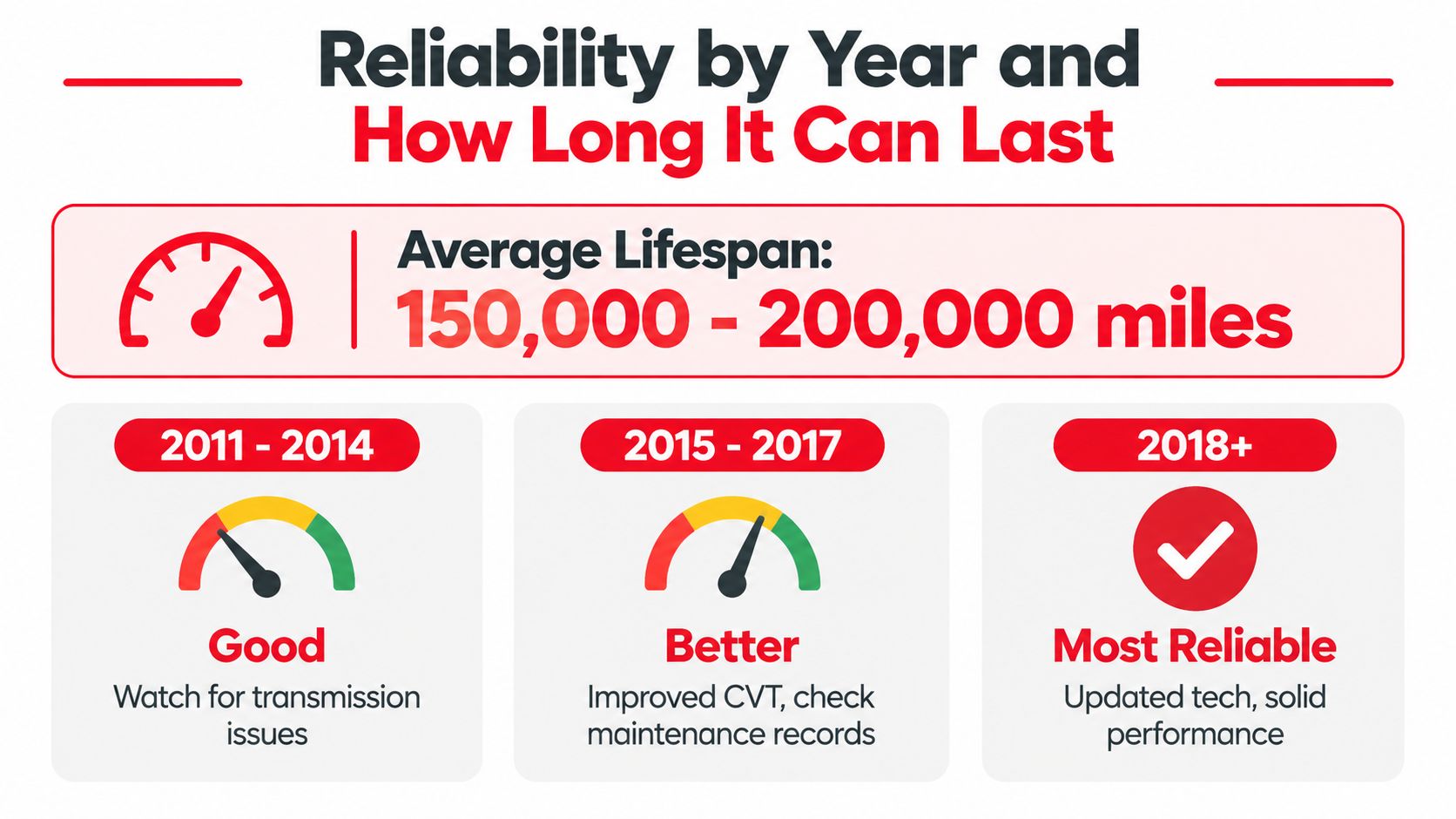
A useful way to read the market is simple. The Outlander Sport can make sense as a long-haul used SUV if the year has a cleaner record and the service history is solid. If two listings look similar on the lot, the better choice is usually the one with the cleaner year and better maintenance, even if it costs a little more.
Buyer filter: do not ask whether the model is reliable in general. Ask whether this exact year, this exact mileage, and this exact service history fit your budget.
NYC Inspection Checklist Before You Buy
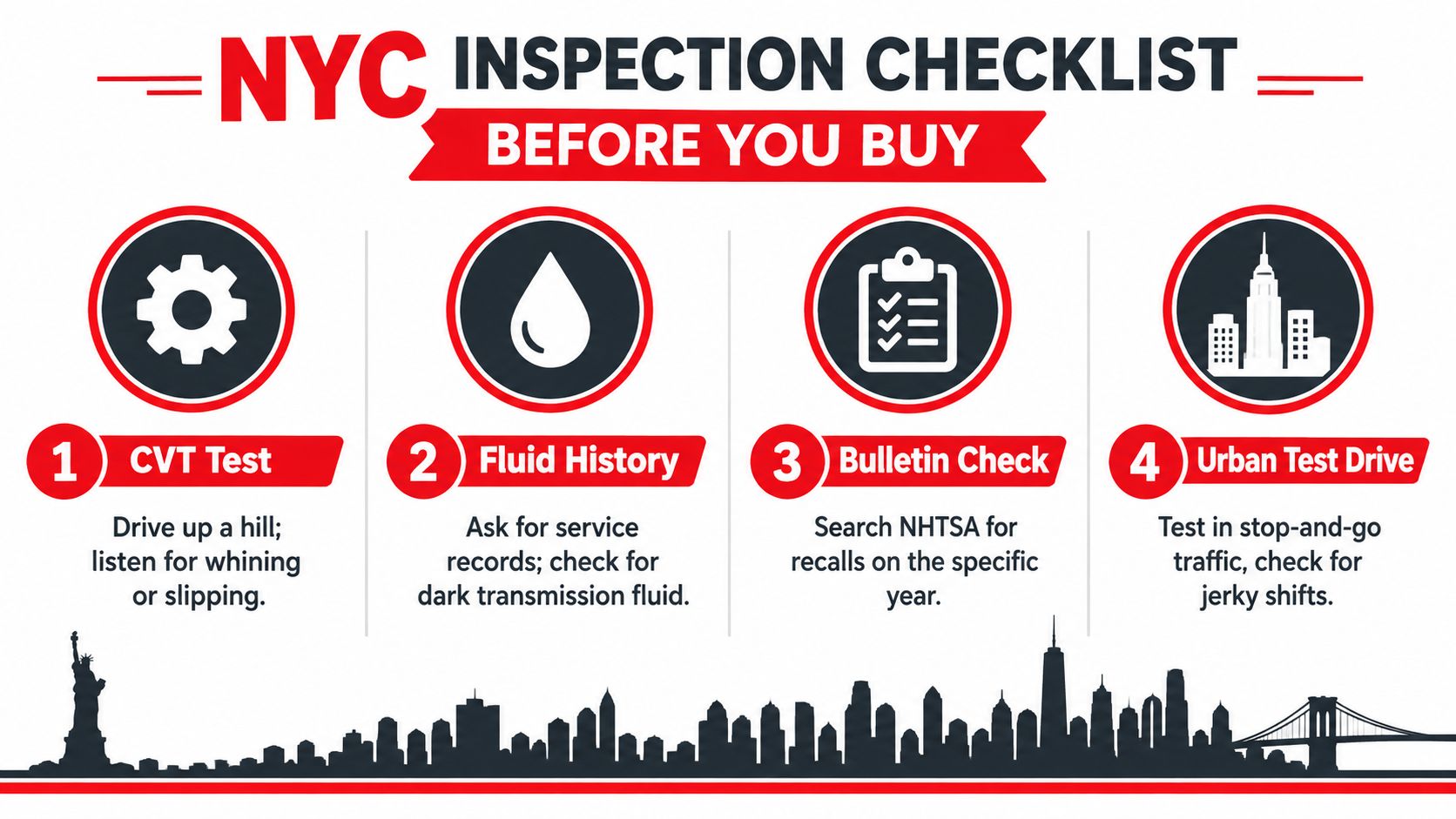
The most important used-Outlander-Sport check in the city is the transmission road test. A NHTSA technical bulletin for 2018 to 2024 2.4L Outlander Sport and RVR models references potential transmission shudder and surge, and independent service guidance notes that high-mileage belt-driven CVTs can lose belt clamping effectiveness as pulley contact surfaces wear smooth, especially during steep climbs, hard acceleration, or towing. NHTSA technical bulletin PDF City driving alone doesn’t always expose that. A flat, easy loop around the block can let a problem hide.
What to do on the test drive
- Drive at steady throttle. Hold a consistent pace and listen for shudder, whining, or a rubber-band feeling that comes and goes.
- Find a slight grade or ramp. Merge, climb, or accelerate in a way that loads the transmission more than a quiet street does.
- Check service records. Ask specifically about CVT fluid service and whether any transmission-related bulletin work has been done.
- Repeat the same route after warm-up. Some issues show up more clearly once the car has been driven for a few minutes.
A short, calm route through neighborhoods is fine as a start, but it shouldn’t be the whole test. You want a mix of stop-and-go traffic, a merge, and at least one situation where the engine has to work a bit harder. If the car feels smooth only when it’s coasting around low-speed blocks, that’s not enough proof.
Practical rule: CVT problems often show up under load, not during a relaxed loop. If the seller resists a longer drive, treat that as information.
It also helps to check the car when it’s parked. Look at the tires, listen for idle roughness, and open the service history before you get emotionally attached to the color or trim. A good used SUV is usually the one that can explain itself cleanly when you ask detailed questions, not the one with the slickest photos.
Typical Pricing and True Cost of Ownership in the City
A used Outlander Sport often lands in a budget-friendly compact-SUV bracket rather than a premium one. One source places the used 1- to 5-year-old Outlander Sport between $12,950 and $23,998. That range helps explain why it keeps turning up in NYC searches, especially for buyers who want an SUV shape without a payment that starts feeling like a second rent bill.
Price is only the first layer. The base engine returns about 23 mpg city, 29 highway, and 26 combined, while the 2.4-liter version drops to roughly 25 combined, which is below many rivals that clear 30 mpg highway according to recent review coverage. The Car Connection Outlander Sport page For a driver who spends the week on surface streets, in traffic, and doing short hops between boroughs, that fuel gap can matter more than a small difference in sticker price.
Safety and cost go together
The same review coverage notes that the 2025 model carries a four-star overall NHTSA rating, and IIHS coverage remains incomplete, so shoppers do not get a fully reassuring safety picture even though standard driver-assist tech helps. That matters in the city, where a parking scrape, a tight merge, or a sudden stop can turn a small oversight into a real expense.

A smart city buyer asks three practical questions before signing anything. How much gas will this burn in my commute? Does this year feel safe enough for my comfort level? Will I spend extra on inspection work, transmission service, or quicker replacement parts because the car has already lived a hard urban life?
That is the ownership math. A low purchase price can still turn expensive if the car is thirsty, tied to a riskier year, or likely to need more frequent upkeep. The best value is the one that still looks like a bargain after you factor in the street-by-street reality of owning it in the city.
Financing Trade In and Closing Your Purchase at Northstar Mitsubishi
Once you’ve narrowed the year and trimmed the risk, the last step is making the deal clean. Start with a pre-qualification, because it gives you a realistic idea of your monthly range before you walk into the store. Then compare that with the dealership’s payment calculator and any trade-in estimate you’ve already collected, so you can separate the car’s price from the financing terms.
A trade-in matters because it can reduce the amount you need to finance, but only if you know what the old car is worth before the handshake. Bring the title or payoff information, registration, insurance card, and a driver’s license, then compare the offer against any independent valuation you’ve already checked online. That way, the number you accept is based on the market, not on how tired you are after a long test drive.
Northstar Mitsubishi in Long Island City offers used vehicles, financing tools, trade valuation, credit pre-qualification, and a service center, which makes it a workable stop for NYC shoppers who want to move from research to paperwork without bouncing between a bunch of separate places. If you’re comparing several used Outlander Sport listings, use those tools to keep the process organized and to confirm whether the car you liked on the road still makes sense on the numbers.
The cleanest closing deal is the one where the test drive, the service history, and the financing worksheet all point to the same car.
If you’re ready to compare used Outlander Sport options in person, bring your notes, your trade-in information, and your financing questions to Northstar Mitsubishi. Their inventory and finance tools can help you narrow the right year, the right trim, and the right payment before you commit.
0 comment(s) so far on Mitsubishi Outlander Sport Buying Guide for NYC